Systems
The Zabaleen
The garbage people who recycle 80%
The pigs were the first mistake.
In 2009, Egypt's government ordered the slaughter of all pigs in the country — roughly 300,000 animals — citing swine flu fears. The decision was medically pointless (swine flu doesn't spread from pigs to humans through proximity) but politically useful. Egypt's pigs were raised by the Zabaleen, a Coptic Christian community that had collected Cairo's garbage for generations. The pigs ate the organic waste. Without them, the system collapsed.
Within months, garbage piled in the streets. Rats multiplied. The government's replacement — multinational waste management companies — proved catastrophically inadequate. The companies collected trash but didn't sort it. Everything went to landfill. Recycling rates plummeted from 80% to under 20%.
The Zabaleen were invited back.
The System
The Zabaleen — the name means "garbage people" in Arabic — migrated to Cairo from Upper Egypt in the 1940s. They developed an informal but remarkably efficient waste management system: door-to-door collection, hand sorting, and recycling of everything that could possibly have value.
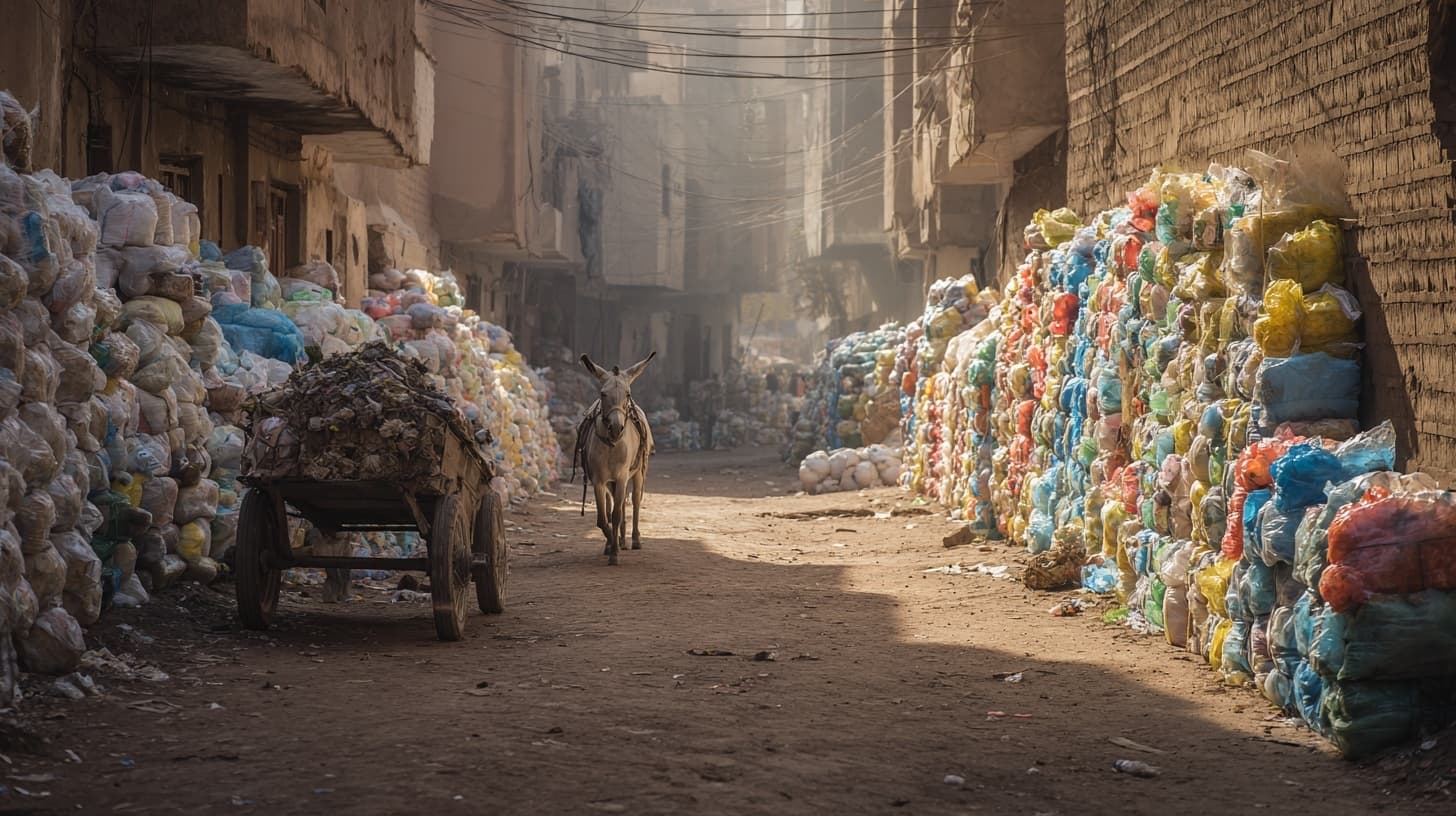
Organic waste fed pigs (until 2009). Paper went to paper merchants. Plastics were sorted by type, washed, shredded, and sold to manufacturers. Metal, glass, textiles — everything had a destination. The Zabaleen processed roughly 9,000 tons of garbage daily, recycling 80-85% of it.
By comparison, the best municipal recycling programs in wealthy countries achieve 30-40%. The European average is 27%. The Zabaleen, working without government support, with hand tools and donkey carts, outperformed everyone.
How It Works
The economics are simple: the Zabaleen are paid twice. Once by households for collection. Once by recyclers for sorted materials. The profit is in the sorting.
A modern waste management company collects a fee, dumps everything in a landfill, and walks away. There's no incentive to sort because sorting is labor-intensive and landfill is cheap. The Zabaleen can't afford landfill. Their margin comes from extracting value from waste. Every plastic bottle, every scrap of cardboard, every piece of fabric has a price.
The sorting happens in Mokattam, a sprawling settlement on the cliffs above Cairo. Entire streets specialize in single materials: one block for clear plastic, another for colored, another for paper. Children sort alongside adults. The work is dirty, dangerous, and badly paid. It is also irreplaceable.
The Alternatives
When European waste companies won Cairo's garbage contracts in the 2000s, they promised modern efficiency. They delivered none. Their trucks were too large for Cairo's narrow streets. Their workers refused to climb stairs or sort waste. Their landfill-focused model was designed for wealthy cities with high disposal budgets, not developing cities where recycling is economically essential.
The companies eventually left. The Zabaleen remained.
The Tension
The Zabaleen system is not romantic. The work is exploitative. Child labor is common. Health conditions are terrible. The community is marginalized, discriminated against, physically segregated on Cairo's outskirts.
But the system works. It processes more waste more efficiently than any replacement. The government has tried modernization, formalization, and corporate contracts. Each time, the garbage piles up until the Zabaleen return.
The Question
What makes a system work? Not elegance. Not technology. Not official approval. The Zabaleen system works because the incentives align: every piece of waste sorted is money earned. The sorting is the business model.
Modern waste management separates collection from value extraction. Someone else's problem. Someone else's profit. The Zabaleen never made that separation. They can't afford to.
Sources
- Fahmi, W. and Sutton, K. Cairo's Zabaleen garbage recyclers. Habitat International, 2006
- Assaad, M. Spirit of Youth: The Story of a Garbage Village. UNESCO, 2010
- World Bank. What a Waste 2.0: A Global Snapshot of Solid Waste Management, 2018
- Golia, M. The Zabballeen of Cairo. Cairo Observer, 2014
- Slackman, M. Cleaning Cairo, but Taking a Livelihood. New York Times, 2009