Systems
The Terra Preta
The soil that shouldn't exist
The soil was in the wrong place.
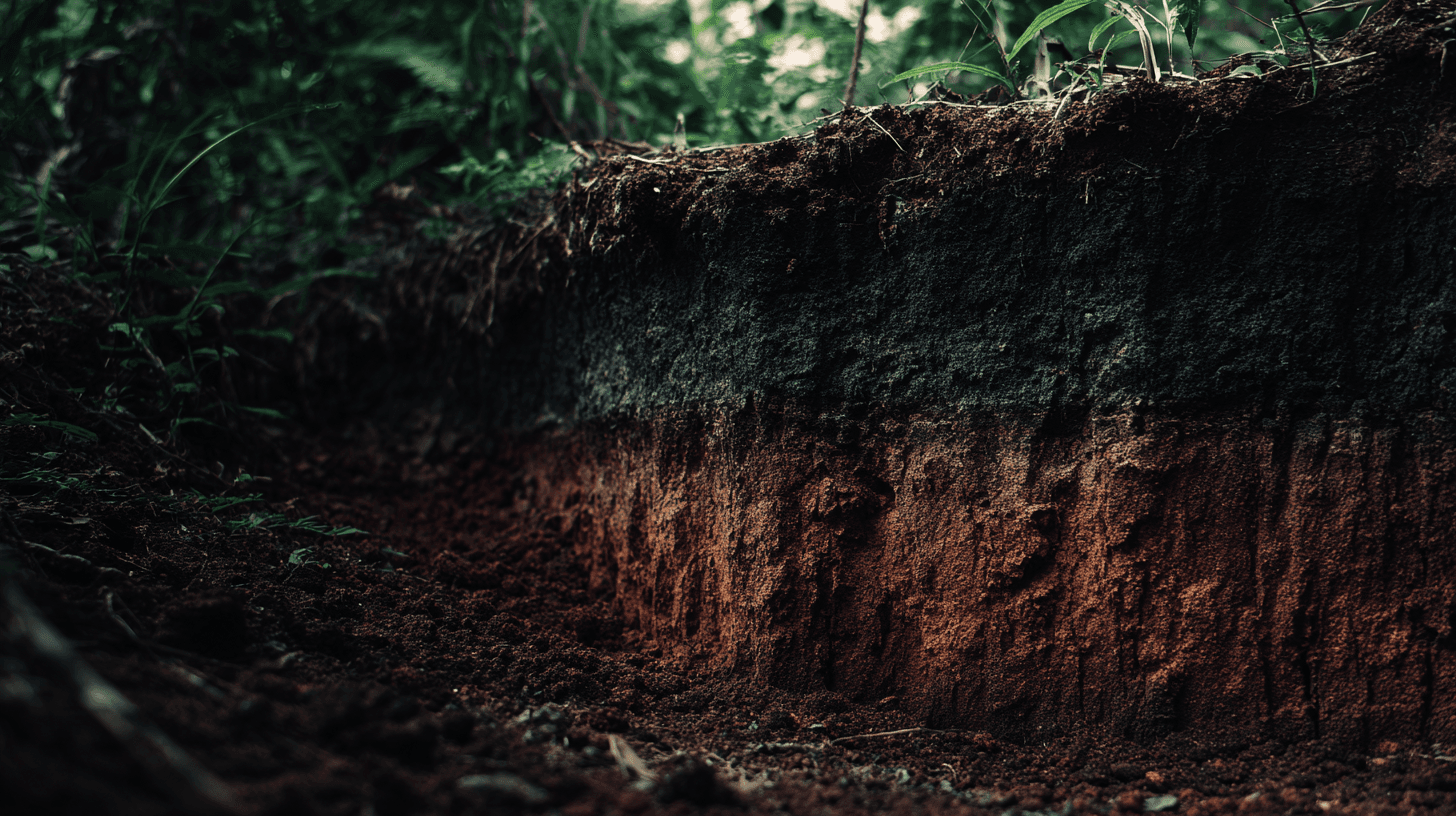
Amazonian soil is supposed to be thin and nutrient-poor — a red laterite that loses its fertility within years of clearing. The forest's nutrients are in the biomass, not the ground. This is why slash-and-burn agriculture fails long-term. This is why the Amazon was considered unsuitable for large populations.
Then scientists found the black earth.
Scattered across the Amazon basin, in patches ranging from hectares to square kilometers, lies terra preta do índio — "black earth of the Indians." It's visibly different: dark instead of red, rich instead of sterile, often three meters deep. It contains pottery shards, bone fragments, and charcoal. It's clearly human-made. And it's still fertile after 500 to 2,500 years.
This shouldn't be possible. Tropical soil doesn't stay fertile. Nutrients leach. Organic matter oxidizes. The Amazon's heat and rain should have washed the terra preta clean centuries ago.
It didn't.
The Discovery
European scientists noticed the black soil in the 1870s but assumed it was volcanic or geological. Only in the late 20th century did radiocarbon dating reveal the truth: the terra preta was cultural, created by pre-Columbian civilizations that were supposedly too primitive to modify their environment at scale.
The dates range from 450 BCE to 950 CE. The pottery styles vary. Different peoples, different times, different locations — but the same result: engineered soil that outlasted the civilizations that made it.
The Secret
Charcoal. Specifically, biochar — organic matter burned at low oxygen to create a stable, porous carbon.
Ordinary organic matter decomposes in tropical conditions. Charcoal doesn't. Its carbon structure is too stable. The porous surface hosts beneficial microbes. The negative charge holds nutrients that would otherwise wash away. Mix charcoal with organic waste, pottery fragments (which also hold nutrients and moisture), and time — and you get soil that improves rather than depletes.
Modern soil scientists call this "black carbon persistence." The ancients called it agriculture.
The Scale
Terra preta covers an estimated 10% of the Amazon basin — roughly 50,000 square kilometers, an area larger than Switzerland. Some researchers argue the true extent is much larger, hidden under forest that regrew after European diseases killed 90% of the indigenous population in the 1500s.
The implications are uncomfortable. The Amazon was not pristine wilderness. It was a managed landscape, engineered for human habitation, abandoned only because its engineers died. The "virgin forest" that conservationists seek to protect is partly regrowth on human-created soil.
The Applications
Biochar is now a research priority. The same process that created terra preta — pyrolysis of organic matter — can be replicated at scale. Trials show improved crop yields, reduced fertilizer needs, and carbon sequestration. The charcoal locks carbon in soil for centuries instead of releasing it to the atmosphere.
Companies sell biochar as a soil amendment. Governments fund biochar research for climate mitigation. The ancient technique has a modern market.
The Missing Piece
We can make charcoal. We struggle to make terra preta.
The original engineers didn't just add charcoal. They added specific mixtures of organic waste, broken pottery, fish bones, and human waste over generations. The soil wasn't manufactured — it was cultivated, a living system that required continuous input. The recipe included time.
Modern biochar projects produce charcoal. Whether they can reproduce the self-sustaining fertility of terra preta — soil that stays fertile for millennia — remains unproven. The engineers are gone. Their complete knowledge went with them.
Sources
- Glaser, B. and Birk, J.J. State of the scientific knowledge on properties and genesis of Anthropogenic Dark Earths. Geochimica et Cosmochimica Acta, 2012
- Mann, Charles C. 1491: New Revelations of the Americas Before Columbus. Knopf, 2005
- Lehmann, J. et al. Biochar for Environmental Management. Routledge, 2015
- Woods, W.I. et al. Amazonian Dark Earths: Wim Sombroek's Vision. Springer, 2009
- Nature. Terra Preta special issue, 2006