Systems
The Stone Money
The currency too heavy to steal
The people of Yap use stone discs as currency — some weighing several tons. The stones rarely move. Their ownership is tracked through oral history.
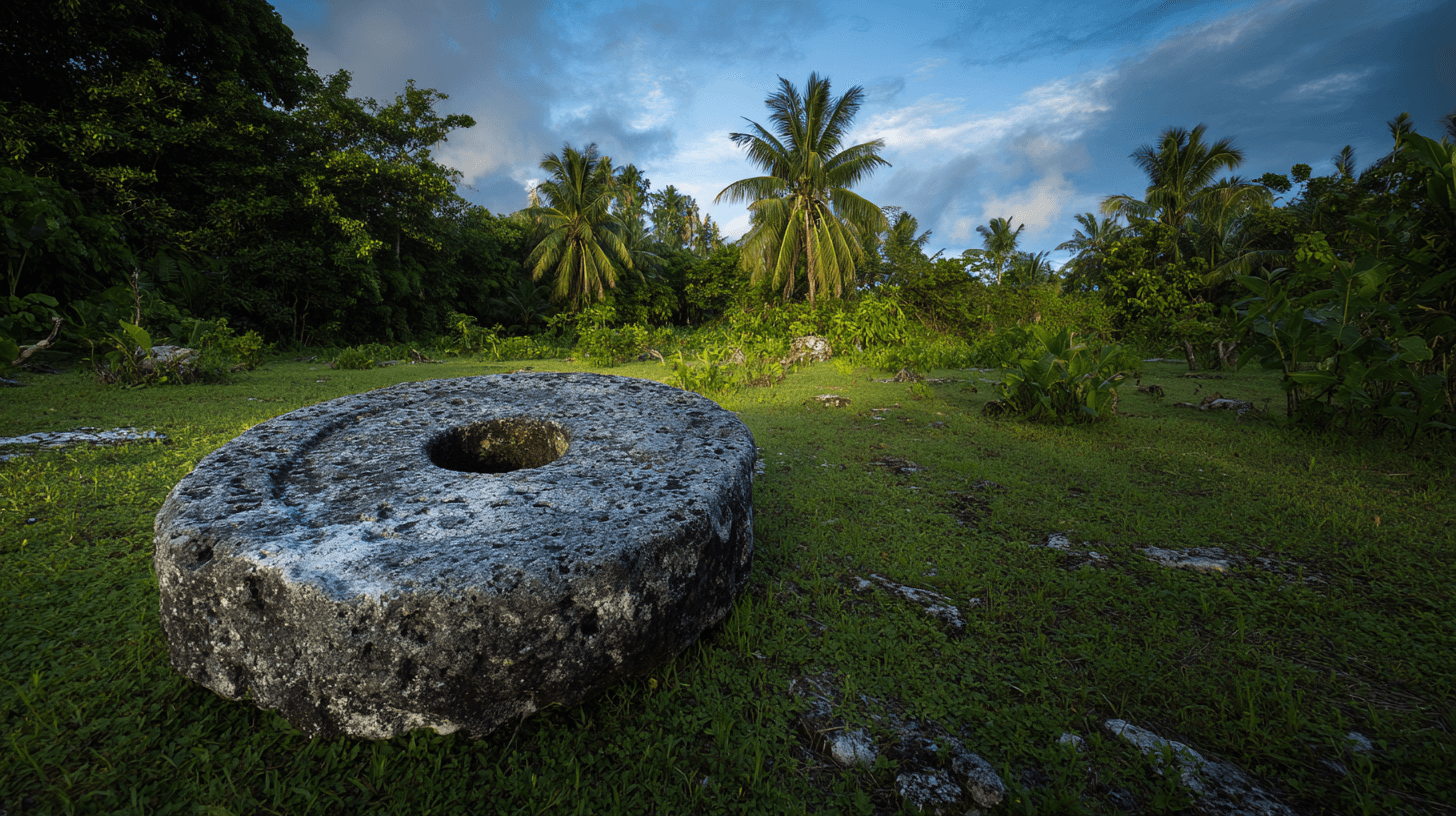
Rai stones are limestone discs carved with a hole in the center. They range from a few centimeters to over 3 meters in diameter. The largest weigh more than a car. They are the traditional currency of Yap, a small island in the western Pacific, and they are among the strangest money systems ever devised.
The stones cannot be easily moved. Many have sat in the same spot for generations. Some are on the bottom of the ocean, lost in transport but still owned, still used in transactions. The value is in the stone itself — its size, its history, the difficulty of its acquisition. Not in its location.
This is money without movement. It is also money that still works.
The Origins
Yap has no limestone. The rai stones were quarried on Palau, an island 400 kilometers away, and transported by canoe across open ocean. The journey was dangerous. Men died. The difficulty of acquisition was part of the value.
A stone's worth depends on several factors. Size matters, but is not determinative. More important is the history — who quarried it, how it was transported, who has owned it, what transactions it has been part of. A stone with a dramatic history is worth more than a larger stone with a mundane one.
One famous stone sits on the bottom of the lagoon. Centuries ago, it was being transported from Palau when a storm swamped the canoe. The stone sank. But the witnesses agreed that the stone existed, that it had been properly made and was being properly transported. The ownership was legitimate. The stone continued to circulate as currency even though no one could see or touch it.
This seems absurd until you realize that modern money works the same way. A bank balance is just a number in a ledger. The dollars do not physically exist in the vault. What matters is the record, the consensus, the social agreement about who owns what.
The Yapese figured this out centuries ago. They just used stones instead of databases.
The System
Rai are not used for everyday transactions. Small purchases use shell money or, today, US dollars. Rai are for major events — land transfers, marriage payments, political agreements, resolution of disputes. They are reserve currency, not pocket change.
When a rai changes ownership, everyone knows. The transaction is announced publicly. The stone's history is updated in the collective memory of the community. The stone stays where it is. Only the ownership changes.
This oral ledger is remarkably robust. The Yapese remember which stones have which histories, who owns them, what transactions they have been part of. The knowledge is distributed — held by the community rather than any single authority. Fraud is nearly impossible because everyone knows the true history.
The system requires social trust. It works because the community is small, because everyone knows everyone, because lying about a stone's ownership would mean lying to neighbors who already know the truth. It is money for societies where reputation matters more than anonymity.
The Survival
Yap was colonized by Spain, then Germany, then Japan, then the United States. Each colonial power introduced its own currency. Each assumed the stone money would disappear.
It did not. The rai continued to circulate alongside foreign currencies. Major transactions continued to be denominated in stones. The traditional system persisted because it served purposes that foreign money could not — connecting transactions to history, embedding exchange in social relationships, marking events with permanent monuments.
Today, Yap uses US dollars for most purposes. But rai stones still matter. Land transactions still reference them. Traditional ceremonies still involve them. The stones themselves still sit where they have always sat — in villages, along pathways, at meeting places — silent monuments to a system that refused to die.
The Lesson
Economists have studied Yap for decades. The stone money system anticipates insights that modern monetary theory claims to have discovered — that money is a social technology, that value is consensual, that the physical form of currency matters less than the ledger that tracks it.
Bitcoin enthusiasts point to rai as a predecessor — a distributed ledger system that predated computers by centuries. The comparison is inexact but illuminating. Both systems solve the same problem: how to track ownership in a way that everyone trusts without relying on a central authority.
The Yapese solved it with stones too heavy to steal and memories too distributed to corrupt. The solution was elegant, durable, and deeply strange to outsiders who assumed that money must be portable to be useful.
It was not portable. It was permanent. That was the point.
What Remains
The stones are still there. Hundreds of them, scattered across the island, each with its own history, its own value, its own place in the memory of the community. Some have sat in the same spot for centuries. Some are newer — the last rai were carved in the early 20th century before colonial authorities banned the practice.
They do not move. They do not need to. What moves is ownership, recorded in the minds of people who remember what their grandparents told them, who will tell their grandchildren in turn.
The system works because the community maintains it. The stones are worth something because people agree they are worth something. The history is true because people remember the truth.
This is what all money requires. The Yapese just made it visible. The stones are a reminder that currency is always, ultimately, a shared story — a consensus about value, maintained by the community that uses it.
The stones remain. The stories continue. The money still works, as strange and permanent as it was when the first rai was carved from Palauan limestone and carried across 400 kilometers of Pacific Ocean to an island that would never stop valuing it.
Sources
- Furness W. (1910). The Island of Stone Money
- Gillilland C. (1975). The Stone Money of Yap
- Goldberg D. (2005). Famous Myths of Fiat Money
- Bryan M. (2004). Island Money