Systems
The Singing Wells
The songs that call the cattle home
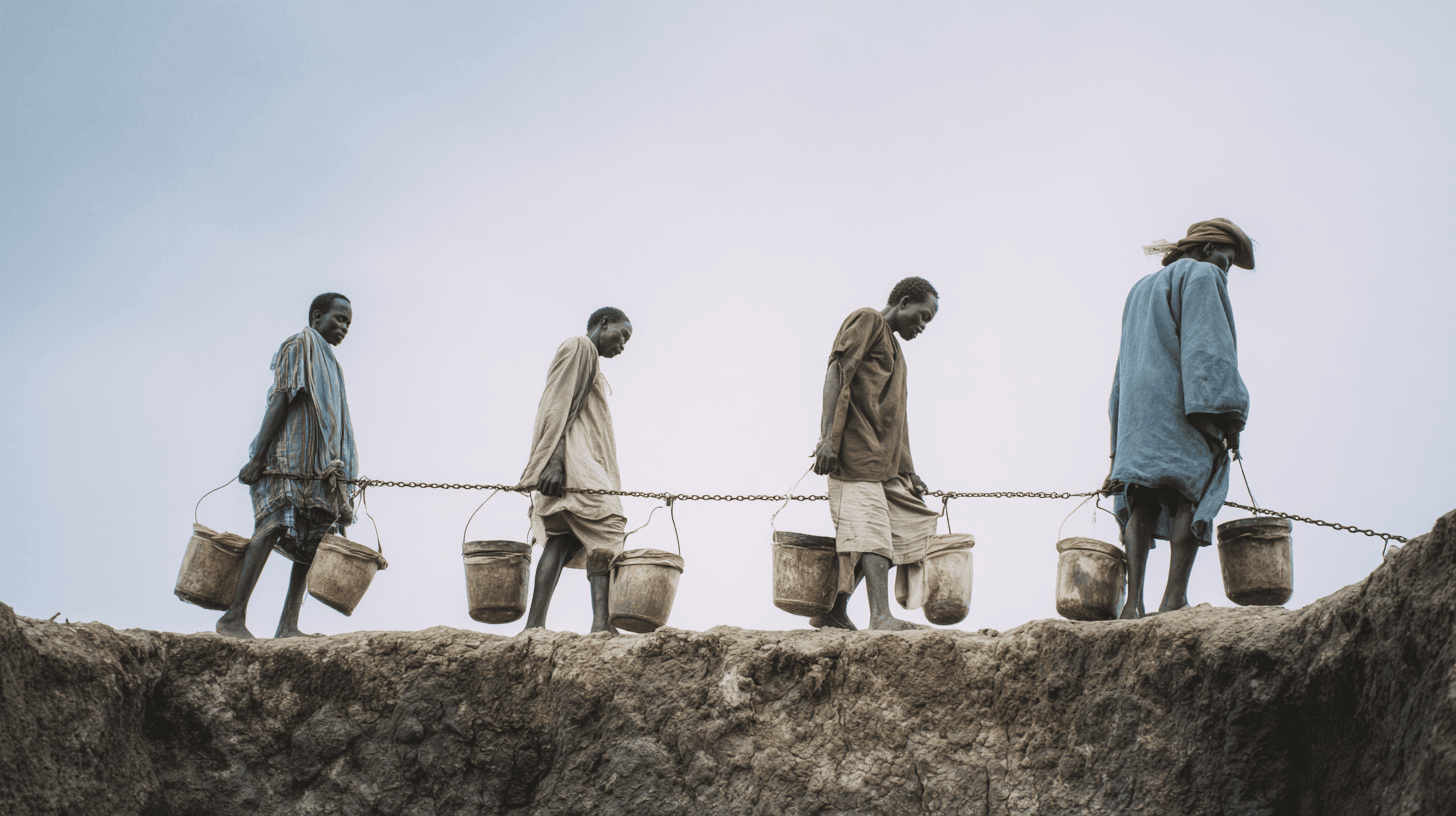
The voices rise from the well shaft. Men stand on carved ledges cut into the rock, passing leather buckets hand to hand in rhythm, singing the water up from sixty feet below. The song coordinates the labor. The labor brings the water. The water keeps the cattle alive.
In the Borana lands of Kenya and Ethiopia, this has been the way for centuries.
In the driest months, when surface water vanishes, they go to the singing wells.
The Wells
A singing well is a hand-dug shaft descending into the earth, sometimes 30 meters or more. At the bottom, groundwater seeps through rock. The water must be lifted by hand, bucket by bucket, to troughs where the cattle drink.
This takes hours. A single well might serve a thousand cattle, each needing 20 to 40 liters per day. The math is brutal: tens of thousands of buckets per day, lifted by human muscle, in heat that exceeds 40 degrees Celsius.
The Borana solved this problem the way humans have solved many problems: they made it social.
The Songs
The wells are worked by teams of men arranged in a human chain. The man at the bottom fills a bucket. He passes it up to the next man. The bucket travels hand to hand until it reaches the top, where it empties into the trough. The empty bucket returns down the chain.
The work is rhythmic: fill, pass, lift, pour, return. And like all rhythmic work, it invites music.
The singing is not entertainment. It is coordination. The songs establish tempo, synchronize movement, pace the effort so that no one burns out too quickly. Different songs for different speeds — slower when the cattle are calm, faster when they're restless, different again when the water level drops and the buckets must travel further.
But the songs also do something else. They call the cattle.
The Calls
Borana cattle know their songs. Each clan, each family, has its own melodies. When the singing begins at a well, the cattle recognize it. They come to the sound, knowing that their water is being drawn, their turn is approaching.
This is not metaphor or myth. Researchers who have recorded the singing wells confirm that cattle respond to specific songs, moving toward wells where their family's melodies are being sung, ignoring wells where other songs play.
The cattle have learned the music. The music has shaped the cattle. Over generations, the animals that responded to the songs were the animals that got water; the animals that got water were the animals that survived. The singing wells are a selection pressure, and the Borana cattle are their product.
The Knowledge
A Borana elder knows not just the songs but their meanings. He knows which melodies signal which families. He knows how to read a cow's behavior to tell whether she's been watered. He knows the depth of each well, the flow rate of the water, the order in which clans may draw.
This knowledge is not written. It exists in memory and practice, transmitted through apprenticeship, tested constantly against the reality of thirst and survival. Get it wrong and cattle die. Get it wrong repeatedly and the family line ends.
The wells themselves require knowledge too. Digging them is a multi-generational project — some wells have been maintained and deepened for over 400 years. The engineering is entirely manual: stone-lined shafts, hand-carved steps, drainage channels to prevent collapse. It is not primitive. It is precisely adapted to the available tools and the local geology.
The Pressure
The singing wells are threatened by modernity, though not in the ways that might be expected.
Motorized pumps can lift water faster than human chains. Boreholes can reach water that wells cannot. The government and aid organizations have drilled hundreds of boreholes across Borana territory, providing water without the labor the wells require.
The wells fall silent. The songs are not sung. The young people who would have learned the melodies learn to operate pumps instead. The cattle still drink, but they drink from concrete troughs filled by diesel engines.
Some Borana celebrate this. The work at the wells was brutal, and they are glad to be free of it. Others mourn. They see the songs disappearing, the social bonds that the wells created weakening, a culture that organized itself around shared labor becoming a culture of individuals and machines.
What Remains
In some areas, the singing wells are still used. The songs still echo up from the shafts. The cattle still come when they hear their families singing.
These are not preserved relics or tourist attractions. They are working infrastructure, maintained because they work, used because they are useful. The pumps have not replaced them entirely. In some places, the wells are more reliable — they do not break down, do not need fuel, do not depend on supply chains that sometimes fail.
The songs, in these places, continue. The men descend into the earth. The buckets pass from hand to hand. The cattle drink.
It is a technology that requires no parts, no fuel, nothing but knowledge and coordination and the willingness to work together. That may be its greatest vulnerability. It requires things that are harder to supply than diesel.
Sources
- Helland J. (1997). Development Issues and Challenges for the Future in Borana
- Oba G. (1998). Assessment of Indigenous Range Management Knowledge of the Borana Pastoralists
- Tache B. and Irwin B. (2003). Traditional Institutions Multiple Stakeholders and Modern Perspectives in Common Property
- Oba G. (2012). Harnessing Pastoralists Indigenous Knowledge for Rangeland Management