Systems
The Salt Readers
The harvesters who know when crystals are ready to be born
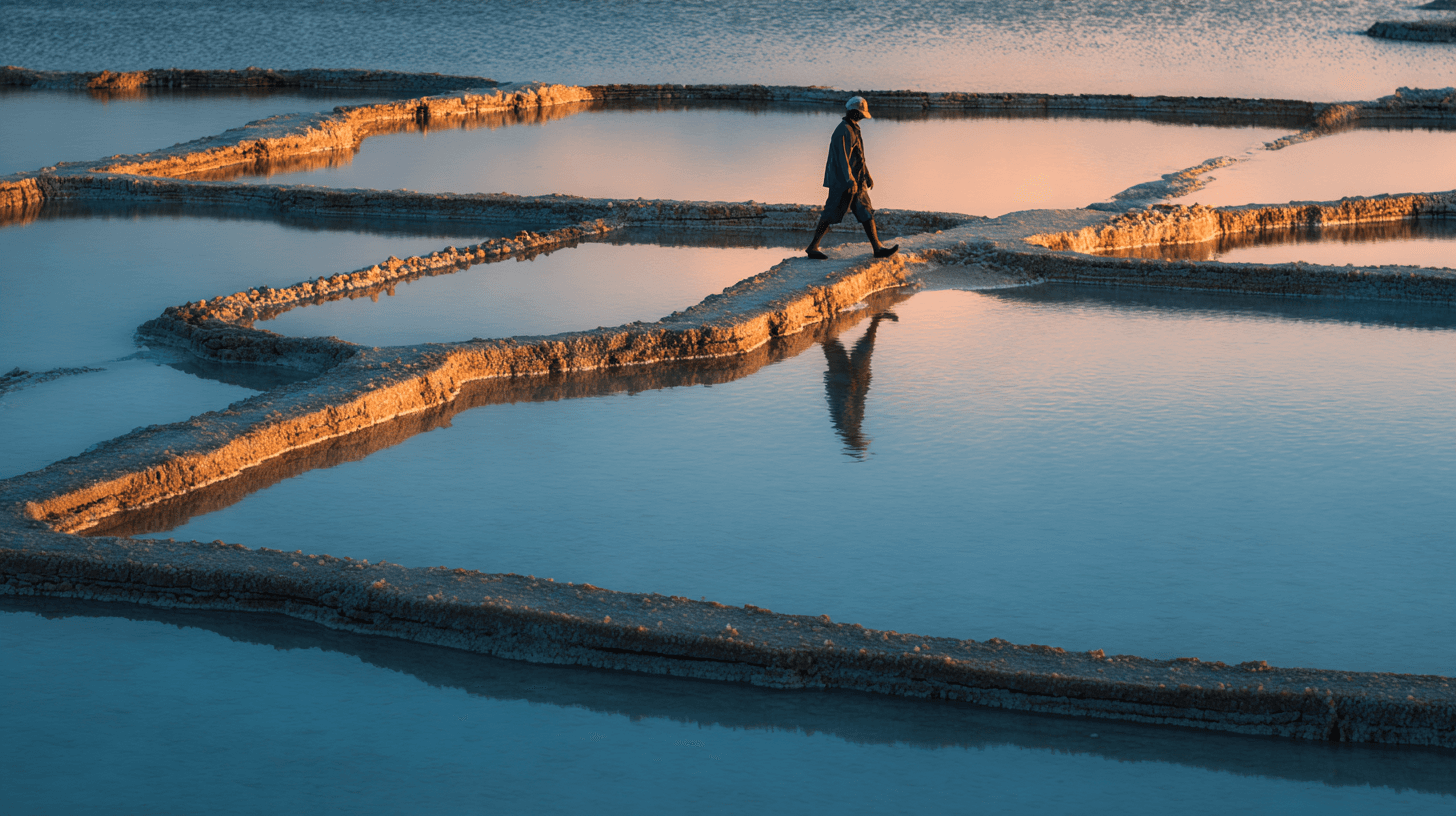
The salt maker walks the pans at dawn. He bends, touches the crust, tastes a crystal. Not yet. Tomorrow.
Solar salt production — evaporating seawater in shallow pans until salt crystallizes — seems simple. Water goes in, sun works, salt comes out. The reality requires judgment accumulated over years.
The Process
Seawater enters the first pond. As it evaporates, concentration increases and the brine moves to successive ponds. Calcium and magnesium precipitate before sodium chloride crystallizes.
The process takes weeks. The timing of movement between ponds affects purity. The salt maker learns to read the brine.
The Reading
The salt reader judges by sight and touch. Brine color indicates concentration. Crystal size and shape indicate conditions. Crust texture indicates readiness.
The reading is continuous. Conditions change with weather. What was ready yesterday may have redissolved in rain.
The Weather
Weather dominates solar salt production. Sun accelerates evaporation. Rain dilutes brine. Wind affects evaporation rate. Humidity matters.
The salt maker watches weather constantly. Production schedules flex around conditions. You cannot command the sun.
The Harvest
Harvest timing matters. Harvest too early and yield suffers. Too late and quality degrades. The right moment is brief.
The harvest itself is physical labor — raking, collecting, piling, transporting. The salt must be moved before conditions change.
The Quality
Salt quality varies with production conditions. Crystal size, purity, mineral content, moisture — all affect the product.
The best solar salts command premium prices. Fleur de sel, harvested as delicate surface crystals, sells for far more than commodity salt.
The Industry
Industrial salt production — mined or vacuum-evaporated — dwarfs solar production. Industrial methods are cheaper, more consistent, weather-independent.
Solar salt survives in niches. Premium quality. Traditional methods. Tourism. The economics are marginal but sufficient where conditions favor.
The Places
Solar salt production concentrates in arid coastal regions. The Mediterranean, the Indian coast, parts of Africa and the Americas. The pans need sun and sea.
Some salt works have operated for centuries. The pans themselves are heritage. The production continues in historical landscapes.
The Taste
Solar salt tastes different from industrial salt. The trace minerals, the crystal structure, the absence of processing — connoisseurs distinguish.
Whether the taste difference justifies the price difference is personal judgment. The difference exists for those who notice.
The Pan
The salt maker returns at dawn. The crust has thickened overnight.
He bends. He tastes. Today.
The raking begins. The crystals pile. The salt that the sun made is gathered by hand.
The process repeats. The reading continues. The salt forms where conditions allow and knowledge persists.
Sources
- Association of Traditional Portuguese Salt Producers; Castro Marim archives; Field interviews