Systems
The Salt Caravans
The road that never ends
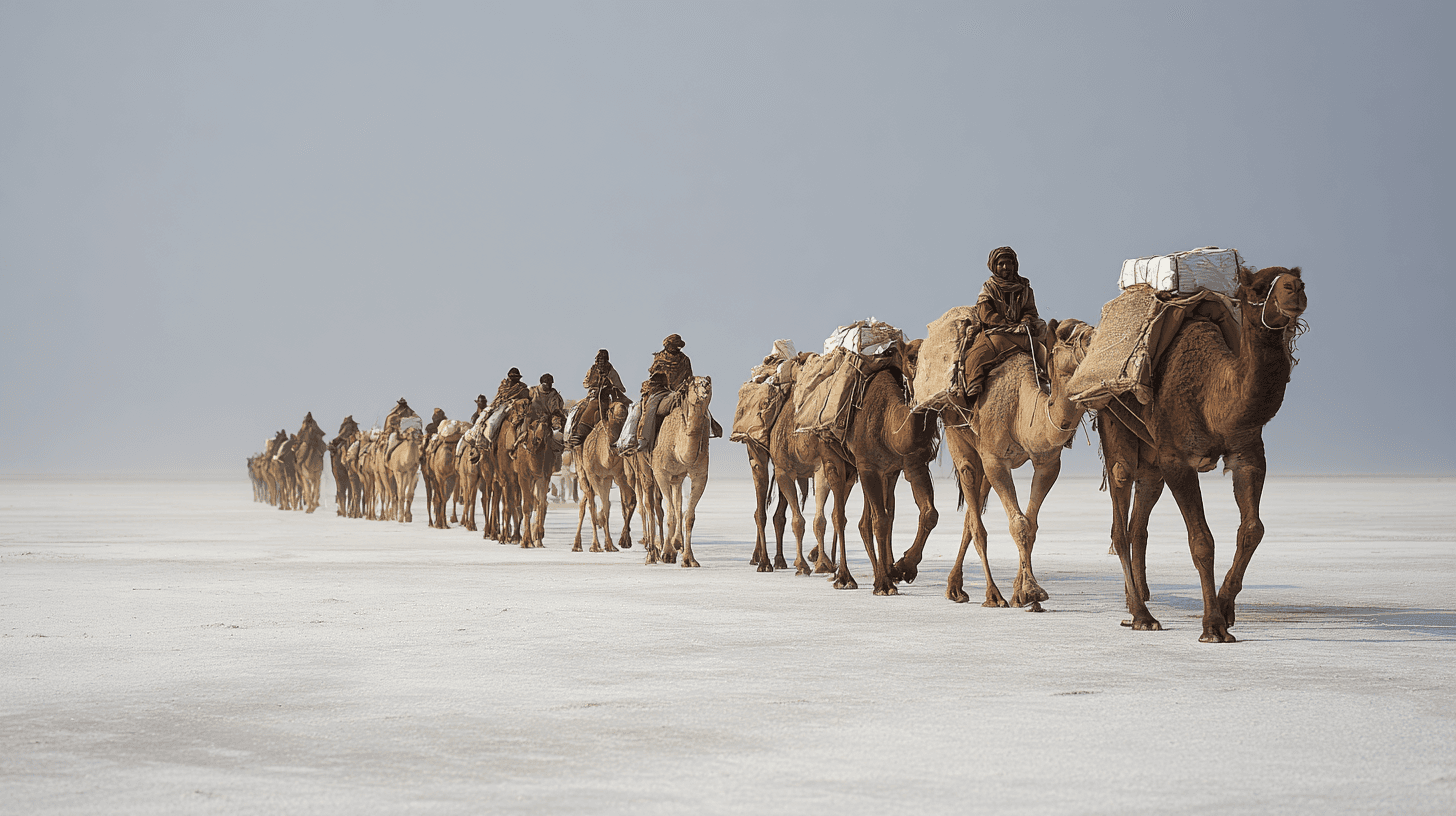
The camels rise at dawn. On their backs: slabs of salt cut by hand from the crusted surface of Lac Assal, the lowest point in Africa. The route ahead crosses the Danakil Depression — the hottest landscape on earth.
The Afar people have walked this route for a thousand years.
Except the salt miners. And the camel drivers. And the traders who have been working this route since before anyone wrote it down.
The Salt
The Danakil was once an arm of the Red Sea, cut off by volcanic activity and evaporated by the sun. What remains is salt — a deposit hundreds of meters thick, stretching for thousands of square kilometers. It is one of the largest salt reserves on earth.
The Afar people who live at the edges of the Danakil have mined this salt for millennia. The technique is simple: cut blocks from the surface, shape them into standardized bars, load them onto camels, walk them out. The route runs from the salt flats to the Ethiopian highlands, a journey of several days through terrain that offers no water, no shade, and no mercy.
The salt bars — called amole — were currency in Ethiopia for centuries. They circulated as money, their value standardized, their weight and dimensions regulated by tradition. Taxes were paid in salt. Wages were paid in salt. The economy of the highlands ran on bars cut from the Danakil floor.
The Miners
The mining happens at night and in the early morning, before the heat becomes unbearable. Workers use hand tools — axes, chisels, levers — to cut blocks from the salt crust. The blocks are trimmed to standard sizes, roughly 4 kilograms each, and stacked for transport.
The work is brutal. The salt is corrosive, eating into skin and eyes. The heat dehydrates faster than workers can drink. The glare off the white flats causes snow blindness. Injuries are common; medical care is not.
The miners are Afar, the ethnic group that has controlled the Danakil for as long as anyone remembers. The salt is theirs by custom and by practical monopoly — no outsider could survive the conditions long enough to compete. Their knowledge of the terrain, the water sources, the safe routes is what makes the trade possible.
The Caravans
The camels arrive in the cool hours, lines of them descending from the highlands. Each camel carries six to eight salt bars — 30 to 50 kilograms of cargo. A large caravan might include 500 camels, a smaller one 50 or 100.
The journey out follows routes that have not changed in centuries. The stopping points are fixed — places where underground water can be found, where the terrain offers some protection from wind, where the camels can rest. The camel drivers know these points the way city people know subway stations.
The trip takes three to five days, depending on conditions. The drivers walk alongside their animals, sleeping briefly at the stopping points, pushing on through the heat because stopping too long means death. Water is rationed carefully. There are no second chances.
The Trade
At the highland markets, the salt is sold to traders who distribute it across Ethiopia and beyond. The prices are low by international standards — a few dollars per bar — but the volume is significant. The Danakil salt trade moves thousands of tons per year.
The economics are marginal. A camel driver might earn the equivalent of a few hundred dollars per trip, against weeks of grueling work in lethal conditions. The miners earn less. The profits, such as they are, accrue to the traders who control the highland markets.
Trucks could do the job faster. Machines could cut the salt more efficiently. Industrial production could undercut the prices. All of this is technically possible and has been proposed at various times.
It has not happened. The terrain defeats vehicles. The heat defeats machines. The Afar resist outside control. The ancient method persists because nothing better has proven workable.
The Future
Climate change is making the Danakil even hotter. Water sources that were marginal are failing. Routes that were barely survivable are becoming impossible for parts of the year. The margin for error, already thin, is thinning further.
At the same time, the economic incentive is weakening. Salt is cheap and available everywhere. The premium for Danakil salt — once based on scarcity — has largely disappeared. Young Afar see little future in a trade that offers hard labor, low pay, and increasing risk.
Some caravans still run. The salt is still cut. The camels still walk the ancient routes. But each year there are fewer miners, fewer drivers, fewer caravans. The economics that sustained the trade for a millennium are eroding faster than the salt deposits themselves.
What Remains
The salt is still there — enough to last for centuries of mining at current rates. The routes are still there — worn into the landscape by a thousand years of camel hooves. The knowledge is still there — held by Afar elders who learned it from their fathers.
What is uncertain is whether the trade will continue. Not because the salt has run out or the routes have closed, but because the people who worked them are finding other ways to live. The caravans may end not with a catastrophe but with a quiet decision, made by young men who see no reason to repeat what their fathers endured.
For now, the camels still descend into the Danakil. The miners still cut the salt. The bars still travel the route that has not changed in a thousand years.
The road has never ended. But roads can empty even when they remain open.
Sources
- Pankhurst R. (1968). Economic History of Ethiopia
- Nesbitt L. (1935). Desert and Forest: The Exploration of Abyssinian Danakil
- Morin D. (2004). Dictionary of the Afar Language
- Fage J. and Oliver R. (1975). Cambridge History of Africa