Systems
The Saffron Harvest
The spice worth more than gold
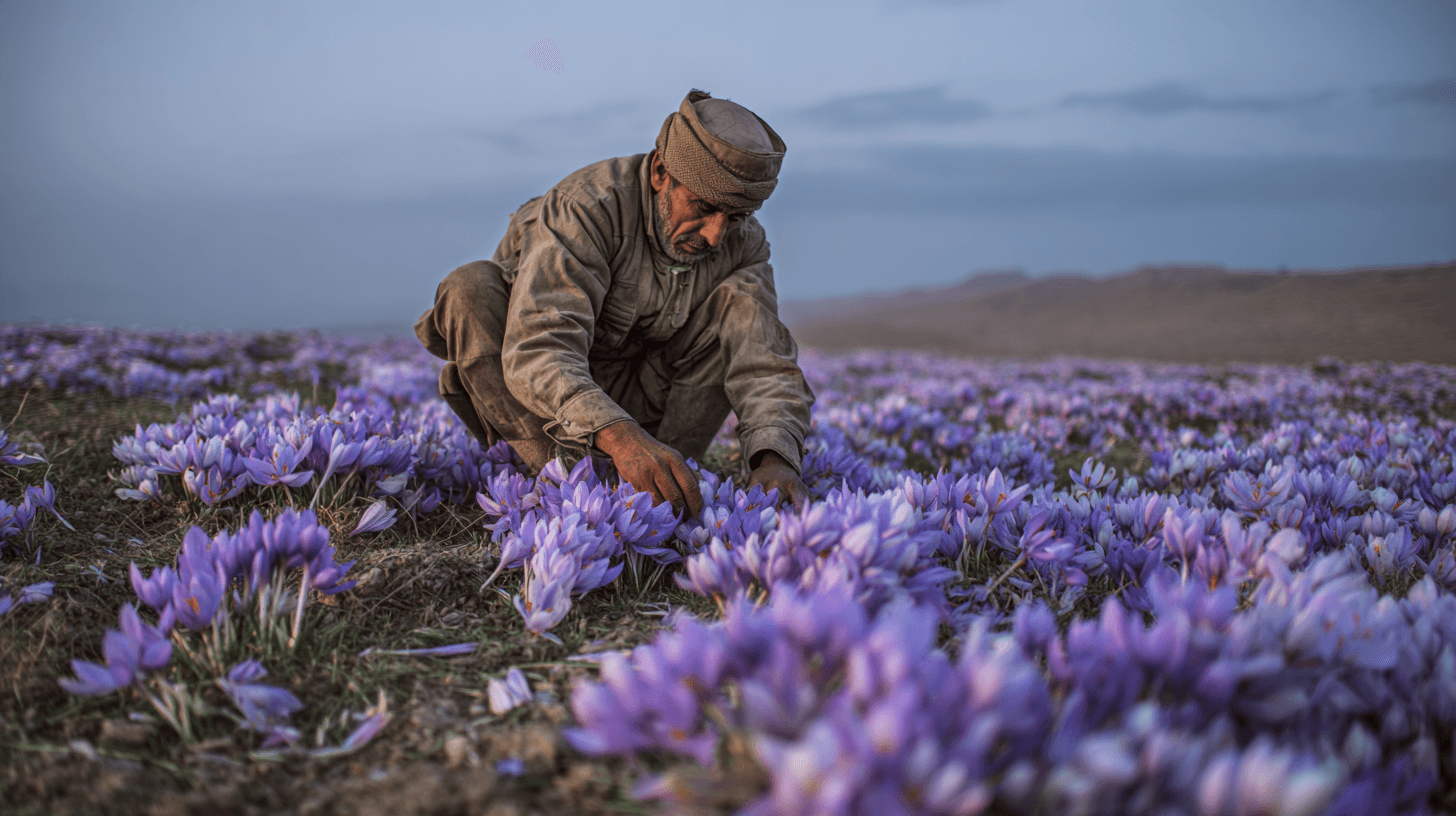
The flower blooms for one day. Inside its purple petals: three crimson threads — the stigmas that, when dried, become the most expensive spice on earth. The harvesters work before dawn, racing the sun, pinching threads from flowers that will be wilted by noon.
Each gram requires 150 flowers. Each flower lasts hours.
The relationship is absolute. Without humans, there is no saffron. Without saffron, there is no flavor, no color, no medicine that has been prized since before written history. The plant and the people need each other.
In Kashmir, this relationship has continued for over a thousand years. The saffron fields of Pampore, south of Srinagar, have produced some of the finest saffron in the world since at least the 12th century. The harvest still happens the way it always has — by hand, at dawn, one flower at a time.
The Flower
The crocus blooms in late October and early November, when the nights grow cold and the days shorten. The timing is precise. The flower emerges from the soil, opens its purple petals, and reveals three crimson stigmas — the threads that, when dried, become saffron.
Each flower blooms for a single day. By evening, the petals begin to close. By the next morning, the flower is finished. The stigmas must be harvested during the narrow window when the flower is open and the threads are at their peak.
This means harvesting at dawn. The pickers enter the fields as the sun rises, working quickly through the rows, plucking each flower and placing it in baskets. The work is delicate — the flowers bruise easily, and bruised stigmas lose value. Speed and gentleness must coexist.
A skilled picker can harvest perhaps 10,000 flowers in a day. Those 10,000 flowers will yield about 30 grams of dried saffron — less than an ounce. This ratio explains the price. Producing a single kilogram of saffron requires roughly 150,000 flowers, each picked by hand, each processed individually.
The Processing
After picking, the flowers are taken to sorting areas where the stigmas are separated from the petals. This too is done by hand. The three red threads are pulled from each flower and placed on trays. The petals are discarded or composted.
The stigmas are then dried — traditionally over charcoal, now often in electric dryers. The drying must be careful. Too much heat destroys the volatile compounds that give saffron its flavor and aroma. Too little and the threads will mold. The process takes skill developed over generations.
The dried threads are graded by color, length, and aroma. The finest saffron — the tips of the stigmas, deepest red, most aromatic — commands the highest prices. Lesser grades, including the yellow styles attached to the stigmas, sell for less. The grading is done by eye and nose, by people who have handled saffron their entire lives.
The Economics
Kashmiri saffron sells for $1,000 to $5,000 per kilogram, depending on grade and market conditions. By weight, it is more valuable than gold. The comparison is not metaphorical — saffron has literally been used as currency, as tribute, as a store of value throughout history.
Yet the farmers who grow it are not wealthy. The fields are small, often less than a hectare per family. The yield is modest — perhaps a kilogram or two per hectare in a good year. The labor is intensive. The income, spread across a year, amounts to a modest supplement rather than a fortune.
The economics are further complicated by adulteration. Saffron is frequently faked — dyed threads, mixed with cheaper materials, diluted with inferior grades. Kashmiri saffron competes with these fakes and with legitimate production from Iran, Spain, and elsewhere. The premium for authenticity is real but requires trust that is difficult to establish.
The Decline
The saffron fields of Kashmir are shrinking. In 1997, the region had roughly 5,700 hectares under cultivation. By 2020, this had fallen below 3,500 hectares. The decline continues.
The reasons are multiple. Urban expansion claims agricultural land. Water tables are dropping as demand increases. Climate change is altering the temperature patterns that trigger blooming. Young people prefer wage labor to the uncertainty of farming.
Most damaging is the conflict that has plagued Kashmir for decades. Violence disrupts harvests. Curfews prevent farmers from reaching fields. Markets are unreliable. Investment in irrigation and infrastructure has lagged. The saffron economy suffers alongside everything else.
The Indian government has launched programs to support saffron cultivation — subsidized corms, irrigation projects, quality certification. These help but do not solve the underlying problems. The fields continue to shrink.
What Remains
The crocus still blooms each autumn in the fields of Pampore. The farmers still rise before dawn, still walk the rows, still pick the flowers one by one. The stigmas are still separated, dried, graded, sold.
The saffron of Kashmir is still among the finest in the world. Its flavor is distinctive — earthy, floral, slightly bitter, unlike saffron from anywhere else. Connoisseurs seek it out. Chefs prize it. The reputation built over a millennium persists.
What is uncertain is whether the tradition will persist with it. The economics are marginal. The labor is hard. The young people are leaving. The fields are smaller each year.
But for now, each October, the purple flowers open in the cold Kashmiri dawn. The pickers move through the rows. The threads are harvested, dried, packaged, shipped to kitchens around the world where a pinch of crimson transforms a dish into something luminous.
Three threads per flower. One day per bloom. A thousand years of cultivation in the valley beneath the mountains. The spice worth more than gold, produced the only way it can be produced — by hand, at dawn, one flower at a time.
Sources
- Husaini A. et al. (2010). Saffron: A potential drug-supplement for severe acute respiratory syndrome
- Fernández J. (2004). Biology, Biotechnology and Biomedicine of Saffron
- Nehvi F. et al. (2007). Saffron in Kashmir
- Gresta F. et al. (2008). Saffron, An Alternative Crop for Sustainable Agricultural Systems