Returns
The Rhino Mothers
The two who remain
Najin and Fatu are the last northern white rhinos on earth. Both are female. What comes next is science fiction made real.
The numbers tell a simple story. In 1960, there were over 2,000 northern white rhinos. By 1984, there were 15. By 2018, there were three — a male named Sudan and two females, his daughter Najin and granddaughter Fatu. When Sudan died in March 2018, the subspecies became functionally extinct.
Two females cannot reproduce alone. The math is absolute.
And yet the story continues. Because before Sudan died, scientists collected his sperm. Because Fatu's eggs can still be harvested. Because a team of reproductive biologists from three continents is attempting something that has never been done: to bring a subspecies back using in vitro fertilization, stem cell technology, and surrogate mothers from another rhino species.
It is not certain to work. It is almost certainly the only chance.
The Last Home
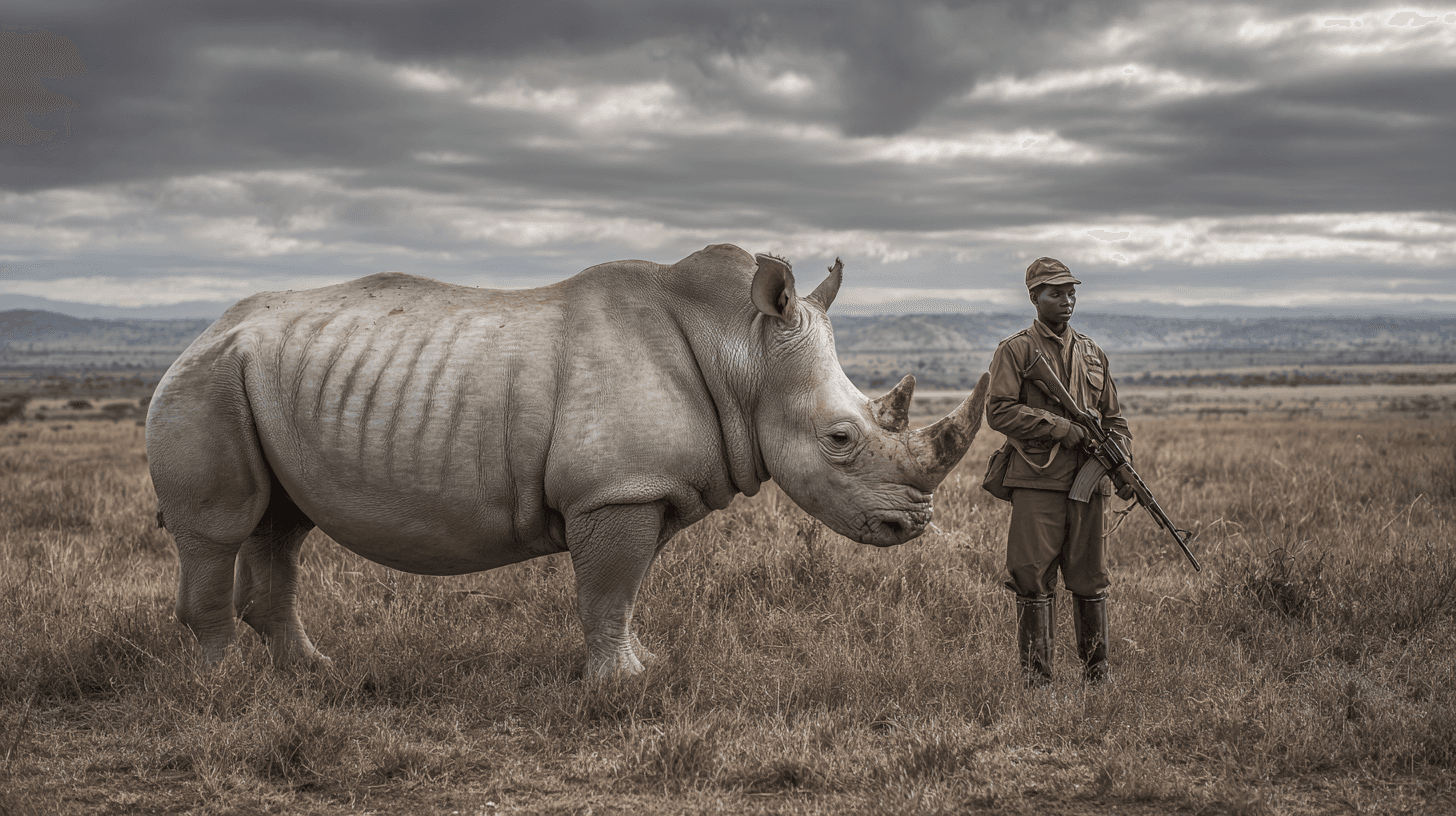
Najin and Fatu live at Ol Pejeta Conservancy in central Kenya, watched around the clock by armed guards. They are the most protected animals on earth. Their paddock has motion sensors, night-vision cameras, and a rapid-response team. Poachers have killed rhinos for less.
The two females cannot contribute to natural reproduction. Najin's hind legs are too weak to support a pregnancy. Fatu's uterus has a condition that prevents embryo implantation. They are alive, healthy, but biologically terminal.
They spend their days grazing, resting, doing what rhinos do. They seem unaware that they are the last of their kind. They seem unaware that they are the subject of one of the most ambitious conservation efforts ever attempted.
The Science
The plan is complex and unprecedented. It proceeds in stages.
First, eggs are harvested from Fatu using techniques adapted from human IVF. This requires sedating a two-ton animal, inserting an ultrasound-guided needle through the rectal wall, and extracting oocytes from the ovaries. The procedure takes hours and involves teams from Germany, Italy, Kenya, and the Czech Republic.
Second, the eggs are fertilized in a laboratory using preserved sperm from Sudan and three other deceased males. The resulting embryos are frozen and stored in liquid nitrogen. As of 2024, there are over 30 viable embryos in storage.
Third — and this is where the fiction becomes science — the embryos will be implanted into southern white rhino surrogates. The two subspecies are similar enough that cross-subspecies pregnancy should be possible. No one has tried it before.
If a surrogate successfully carries a northern white rhino calf to term, it will be the first individual born in over a decade. It will not be the end — rebuilding a population requires genetic diversity — but it will be a beginning.
The Longer Plan
Thirty embryos from four sperm donors is not enough genetic diversity to sustain a species. Even if every embryo produces a calf, the population would be hopelessly inbred within a few generations.
The solution, if it can be called that, is even more ambitious. Scientists are working to create northern white rhino embryos from stem cells. Preserved tissue samples from 12 deceased individuals — skin, blood, bone marrow — could theoretically be reprogrammed into reproductive cells. Eggs and sperm that never existed in nature could be created in a laboratory.
This technology does not yet work. It has never been applied to any rhino. It exists in theory and in preliminary experiments. But it is the only path to real recovery.
The team is not optimistic so much as determined. They know the odds. They continue anyway.
The Question
Is this conservation? The question is asked often, sometimes in good faith, sometimes not.
The critics argue that the money spent on two rhinos could protect thousands of other animals. They argue that a species reconstructed from stem cells is not the same species that existed before. They argue that the northern white rhino's habitat is gone anyway, and that any recovered population would have nowhere to live.
The supporters argue that the science developed for rhinos will apply to other species. They argue that giving up on the last individuals sends a message that extinction is acceptable. They argue that we do not yet know what is possible, and that the attempt itself has value.
Najin and Fatu do not participate in this debate. They graze. They rest. They are protected by men with rifles while scientists work to ensure they are not the end of their line.
What Remains
Two rhinos. Thirty embryos. Twelve tissue samples. A handful of laboratories. A team of scientists who have made this their life's work.
It may not be enough. It may never produce a viable population. The northern white rhino may remain extinct in all the ways that matter.
But the attempt continues. The eggs are harvested. The embryos are frozen. The surrogates are prepared. And somewhere in Kenya, two old females stand in their paddock, not knowing they are the last, not knowing they are the beginning of whatever comes next.
Sources
- Hildebrandt T. et al. (2021). Embryo creation and cryopreservation for northern white rhino
- BioRescue Project Reports 2019-2024
- Saragusty J. et al. (2016). Rewinding the process of mammalian extinction
- Ol Pejeta Conservancy Northern White Rhino Program