Systems
The Olive Press
The oil that built civilizations
Olive oil has been pressed the same way for 6,000 years. In the groves of Andalusia, where 70 million trees cover the hills, the harvest still happens as it did in Roman times.
The olive tree is one of the oldest cultivated plants on earth. Archaeological evidence suggests domestication in the eastern Mediterranean at least 6,000 years ago. The tree spread with civilization — to Greece, to Rome, to Spain, to everywhere around the Mediterranean basin. It became so important that destroying an enemy's olive groves was an act of war, punishable by the gods.
Spain now produces nearly half the world's olive oil. The province of Jaén alone has more olive trees than any country except Spain itself — an estimated 70 million trees covering hills that stretch to every horizon. The landscape is a monoculture of silver-green leaves, the largest olive forest on earth.
The harvest still happens by hand. The pressing still follows principles unchanged since antiquity. The oil that emerges is the same oil that lit Roman lamps, anointed Greek athletes, and fed Mediterranean peoples for longer than history records.
The Tree
An olive tree can live for a thousand years. Some trees in the Mediterranean are documented at over 2,000 years old, still producing fruit, still yielding oil. The tree does not die of old age. It is killed by frost, disease, neglect, or human decision — but not by time.
This longevity creates a relationship between farmer and tree that spans generations. A farmer harvests trees planted by his great-grandfather. He plants trees that will be harvested by descendants he will never meet. The timeline is not human. It is arboreal.
The tree is also remarkably resilient. It tolerates drought that would kill other crops. It grows in poor soil, on steep hillsides, in conditions too marginal for almost anything else. Its deep roots find water where other plants cannot. Its leaves conserve moisture through the brutal Mediterranean summer.
But it is demanding in its own way. An olive tree requires pruning, care, attention. Neglected, it becomes bushy and unproductive. Well-tended, it produces abundantly for centuries. The farmer must understand the tree — its growth patterns, its needs, its responses to weather and treatment.
The Harvest
The olives ripen in autumn and early winter. The timing varies by variety and location, but the harvest typically runs from October through January. The fruit must be picked at the right moment — too early and the yield is low, too late and the oil quality suffers.
Traditional harvesting uses long poles to beat the branches, knocking olives onto nets spread beneath the trees. The method is ancient, depicted in Greek vases and Roman mosaics. It is also labor-intensive, requiring teams of workers who move from tree to tree through the groves.
Modern harvesting increasingly uses machines — vibrating arms that shake the trunks, harvesters that comb through the branches. The machines are faster but cannot reach all trees. On steep slopes, in old groves with irregular spacing, the traditional methods persist.
Speed matters. Once harvested, olives must be pressed quickly — within hours if possible, certainly within a day or two. Delay allows fermentation and oxidation that degrade the oil. The harvest and the pressing are continuous operations, running day and night during the season.
The Press
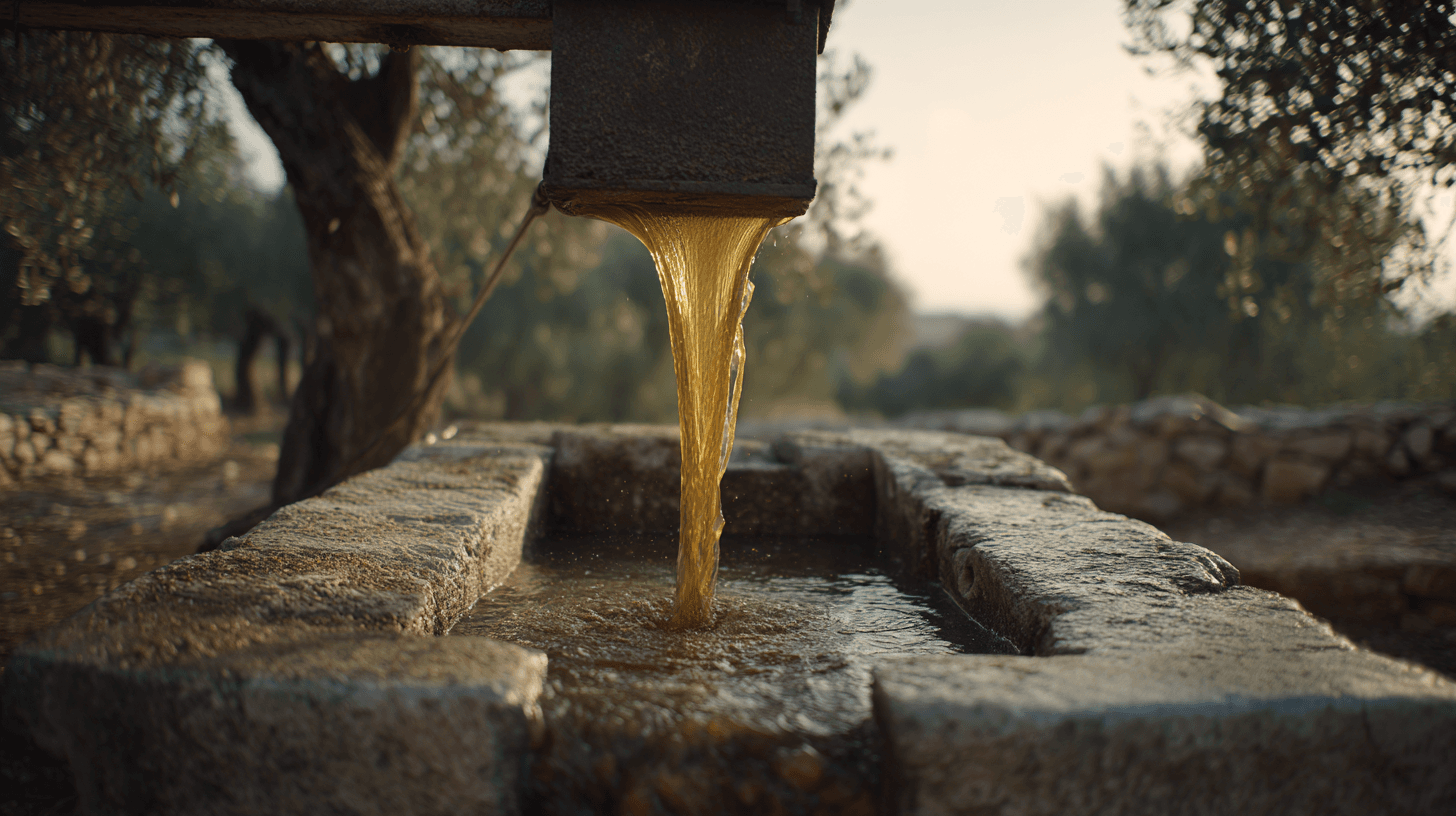
The principle of olive pressing has not changed in 6,000 years: crush the fruit, separate the oil from the solids and water. The methods have evolved — from stone mills turned by donkeys to hydraulic presses to modern centrifuges — but the goal remains the same.
Traditional pressing used a stone mill to crush olives into paste, then stacked the paste between fiber mats and squeezed out the liquids. The oil floated on top and was skimmed off. The process was slow, labor-intensive, and produced oil of variable quality.
Modern mills use centrifugal force. The olives are crushed, the paste is spun at high speed, and the oil separates in minutes rather than hours. The process is faster, more consistent, and more hygienic. The oil that emerges is cleaner and better preserved.
But the sensory evaluation remains human. Every batch is tasted by trained assessors who judge the oil for fruitiness, bitterness, and pungency. Defects are identified by nose and palate. No machine can replicate this judgment. The ancient skill of knowing oil persists alongside industrial technology.
The Economy
Olive oil is big business. Spain exports over a million tons annually, worth billions of euros. The industry employs hundreds of thousands of people, directly and indirectly. The olive groves of Andalusia are not quaint relics — they are industrial agriculture at scale.
Yet the economics are precarious. Prices fluctuate wildly with harvests and demand. Competition from other producing countries intensifies. Climate change is altering growing conditions. The small farmers who own most of the groves struggle to compete with large operations that achieve economies of scale.
The young people leave. The villages of olive country are aging, their populations shrinking as youth migrate to cities. The groves require labor that is hard to find and expensive to pay. Some farmers have abandoned their trees. Others have intensified, planting high-density groves that can be mechanically harvested.
The landscape is changing. The old groves with their ancient trees are giving way to new plantings optimized for production. The change is economically rational and culturally painful.
What Remains
The trees still cover the hills. The harvest still comes each autumn. The presses still run through the winter, extracting oil that people have been extracting for 6,000 years.
The continuity is real but not guaranteed. The economics must work or the groves will be abandoned. The young people must stay or the knowledge will be lost. The climate must cooperate or the trees will fail.
For now, the continuity holds. The oil flows — into bottles, into kitchens, onto tables around the world. The same oil that fed ancient civilizations feeds modern ones. The trees that witnessed the rise and fall of Rome still produce fruit for harvests that their original planters could not have imagined.
Seventy million trees. Six thousand years. The oldest agricultural tradition still practiced at scale, still producing, still feeding people who have mostly forgotten how remarkable it is that the trees are there at all.
Sources
- Vossen P. (2007). Olive Oil: History, Production, and Characteristics
- Ferrara G. et al. (2022). Olive Growing in Spain
- International Olive Council Technical Reports
- Foxhall L. (2007). Olive Cultivation in Ancient Greece