Returns
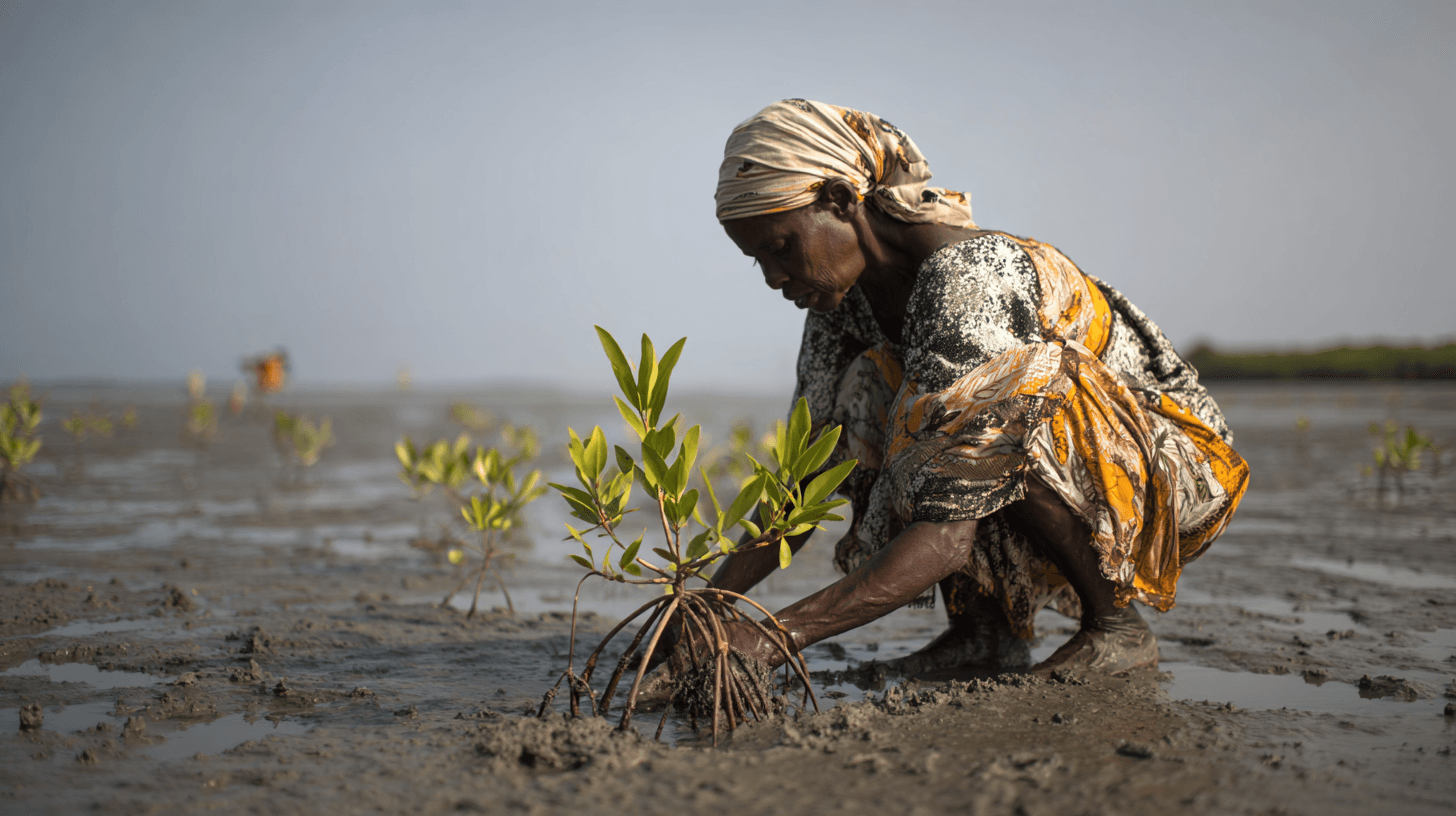
The Mangrove Guardians
The forest the village took back
The fishermen drew a line. Beyond this point, no one cuts. No one takes wood or oysters or fish. The penalty is paid in cattle. The enforcement is absolute.
The government could not protect the mangroves of Casamance. So the village of Mangagoulack decided to do it themselves.
In 2010, the elders of Mangagoulack did something unusual. They declared the mangroves a community-protected area and gave it a name: Kawawana.
The Problem
The Casamance mangroves are among the most productive ecosystems in West Africa. They are nurseries for fish, breeding grounds for shrimp, habitat for birds, protection against coastal erosion. They should be teeming with life.
By the 2000s, they were not. Decades of uncontrolled fishing had stripped the waters. Commercial boats from outside the region worked the area with fine-mesh nets that caught everything, including juveniles that had not yet reproduced. Local fishermen, competing against industrial methods, intensified their own efforts. The classic tragedy of the commons unfolded: everyone took what they could, and soon there was little left to take.
The government had rules, but no way to enforce them. The coast was too long, the waters too remote, the budget too small. The regulations existed on paper. In the mangroves, they meant nothing.
The Decision
The Diola people of Mangagoulack had their own traditions of resource management. Sacred forests, protected by taboo. Seasonal closures of fishing grounds. Rules about who could harvest what, and when. These systems had weakened over generations but had not entirely disappeared.
In 2010, the village council decided to revive them — not just as tradition, but as law. They created Kawawana: a community-managed marine protected area covering over 9,000 hectares of mangroves, estuaries, and coastal waters. The name means this belongs to us in the Diola language.
The rules were strict. No fishing in the core zone, ever. Restricted fishing in the buffer zone, with seasonal closures during breeding periods. No outside boats without village permission. Violators would be fined by the village council, not by distant authorities.
The government had no role in creating Kawawana. It was not a national park or a marine reserve. It was a community decision, enforced by community authority, funded by community resources.
The Resistance
Not everyone was happy. Fishermen from other villages resented being excluded. Commercial operators complained that the village had no right to claim the waters. Even within Mangagoulack, some questioned whether the restrictions would work — whether the fish would return, whether the sacrifice would be worth it.
The first years were hard. Fish catches dropped as the closures took effect. Families that depended on fishing income struggled. Young men who might have stayed to fish left for the cities instead.
But the council held firm. The elders invoked tradition and obligation. The rules were enforced, violators punished. The village bet its future on the idea that the mangroves would recover if given the chance.
The Recovery
By 2015, the bet was paying off. Fish populations in the protected zones were measurably higher than in unprotected areas. Oyster harvests were improving. Bird counts were up. The mangroves themselves were healthier, the water clearer, the ecosystem visibly more alive.
Fishermen from Mangagoulack, working the buffer zones where restricted fishing was allowed, were catching more than fishermen in neighboring areas. The closures had allowed fish populations to rebound, and the spillover from the protected core zone was replenishing the fishing grounds.
Other villages noticed. By 2020, a network of community-protected areas had spread across the Casamance coast. Each village had its own rules, its own council, its own enforcement. What had started in Mangagoulack had become a regional movement.
The Recognition
In 2012, the global conservation organization ICCA Consortium recognized Kawawana as an Indigenous and Community Conserved Area — one of the first in West Africa. The recognition brought visibility, support, and validation.
But the village was careful not to let outside attention change the fundamental nature of the project. Kawawana belonged to Mangagoulack. Outside organizations could support, could advise, could study. They could not control.
This distinction matters. Conservation initiatives imposed from outside often fail when the outsiders leave. Initiatives that emerge from communities, that are controlled by communities, that serve community interests, have a different trajectory. They are not projects that end. They are practices that continue.
What Remains
The mangroves of Kawawana are still there, greener and fuller than they were two decades ago. The fish are returning. The oysters are larger. The birds are back.
The village council still meets, still sets the rules, still enforces the closures. Young people who left are beginning to return, seeing a future that did not exist when they left.
It is not a complete success. Climate change is affecting the mangroves. Upstream dams are altering water flow. The pressures have not disappeared. But the village has something it did not have before: a system that works, controlled by the people who depend on it, protecting the resources they need.
Kawawana means this belongs to us. The statement is also a commitment.
Sources
- Bassene O. (2015). Community-based governance of natural resources in Senegal
- ICCA Registry: Kawawana Case Study
- Borrini-Feyerabend G. et al. (2013). Governance of Protected Areas
- Cormier-Salem M. (2006). Mangrove Spaces and Society in the West African Estuary