Systems
The Khettara
Underground rivers built by hand
The water flows uphill. Or appears to.
A khettara is an underground channel that taps groundwater and delivers it to the surface using nothing but gravity. No pumps. No power. No moving parts. The technology is over 2,500 years old. In Morocco's Tafilalet region, some khettaras have been running continuously for a thousand years.
How It Works
The engineering is elegant. Workers dig a mother well into an aquifer at the foot of a mountain. From there, they tunnel horizontally — or at a grade slightly less than the slope of the land — toward the area needing water.
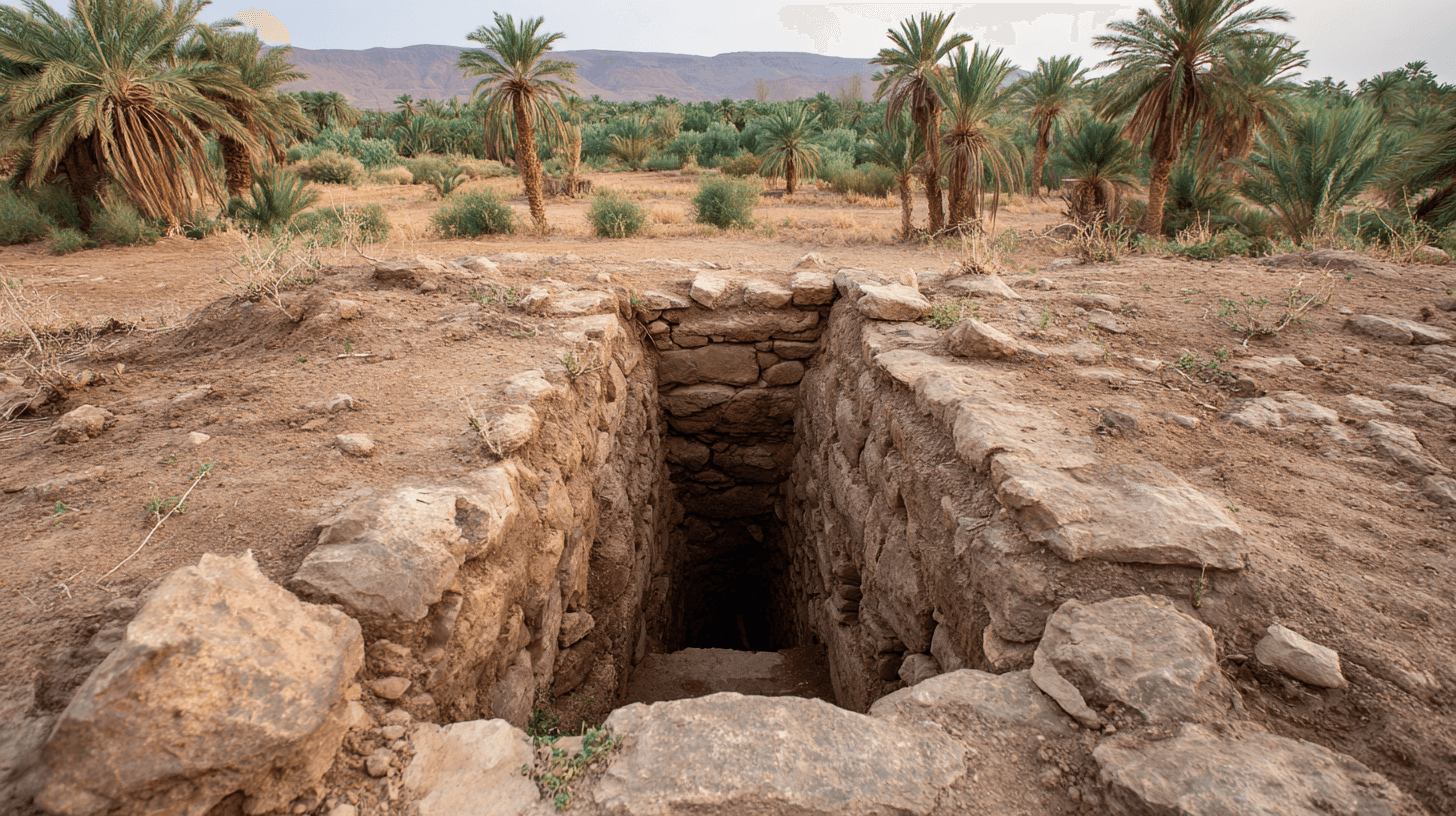
Vertical shafts, spaced every 20-30 meters, provide access for construction and maintenance. From above, a khettara looks like a line of small craters marching across the landscape. Below ground, the tunnel slopes gently downward, the water flowing by gravity alone.
By the time the channel reaches the surface, it can be kilometers from the source. The water emerges into irrigation canals, feeding date palms, gardens, and villages.
The Numbers
The Tafilalet once had over 570 documented khettaras. Fewer than 100 still function. The rest have dried up — victims of dropping water tables, aquifer depletion, and diesel pumps that draw water faster than gravity systems can compete.
A functioning khettara delivers water continuously, year-round, with zero energy cost. A diesel pump delivers more water per hour — until the fuel runs out, or the aquifer drops below reach, or the pump breaks down.
The khettara is slower but doesn't stop.
The Visitors
Engineers and hydrologists from water-stressed regions have been visiting Morocco to study traditional water systems. Delegations from California, Spain, Iran, and North Africa have documented khettara construction techniques.
Iran's qanats — the same technology, different name — are UNESCO World Heritage sites. Spain is restoring medieval foggaras. The interest isn't nostalgic. It's practical.
In a future with expensive energy and dropping water tables, passive water delivery may matter again.
The Math
A khettara requires significant upfront labor — months or years of tunneling. Once built, it requires only periodic cleaning. The operating cost is essentially zero.
A diesel pump requires minimal upfront investment. It requires continuous fuel, maintenance, and eventual replacement. The operating cost is continuous.
Over decades, which system costs less? Over centuries? As energy prices rise and aquifers drop, the calculation changes.
What's Happening Now
Some Moroccan communities are restoring abandoned khettaras. NGOs are funding the work. The government has shown intermittent interest.
The challenge is coordination. A khettara requires collective labor to build and maintain. The shafts must be cleaned. The tunnels must be inspected. Everyone who benefits must contribute work. The social infrastructure is as important as the physical infrastructure.
The pumps are easier. One person can operate a pump. A khettara requires a community.
The Question
The khettara isn't primitive technology that modern engineering has surpassed. It's a different solution to the same problem — one optimized for different constraints.
If the constraints change — if energy becomes expensive, if aquifers become depleted, if resilience matters more than throughput — the old solution might become the new one.
The water has been flowing for a thousand years. It flows still, where the channels remain open. The engineers taking notes are not preserving the past. They're preparing for the future.
Sources
- UNESCO qanat/khettara documentation; Tafilalet water system surveys; Iranian qanat engineering studies; Contemporary passive irrigation research