Systems
The Iron Smelters
The furnaces that made Africa
African iron smelting developed independently, 3,000 years ago. The furnaces produced steel that European technology could not match. The knowledge survived colonialism. Some smiths still practice it.
The conventional story of technology runs from Mesopotamia through Europe to the world. Iron was discovered in Anatolia, spread to the Mediterranean, reached Africa through trade and conquest. Africa was a recipient of technology developed elsewhere.
The archaeological record tells a different story. Iron smelting in Africa dates to at least 1000 BCE — possibly earlier. The technology developed independently in multiple locations. The furnaces and techniques were different from those used elsewhere. Africa invented iron on its own terms.
The implications are still being absorbed. For centuries, Africans were told their ancestors had no technological achievements. The furnaces prove otherwise. The metal that made the Iron Age African is not just history. It is a statement about who invented what, and whose knowledge counts.
The Furnace
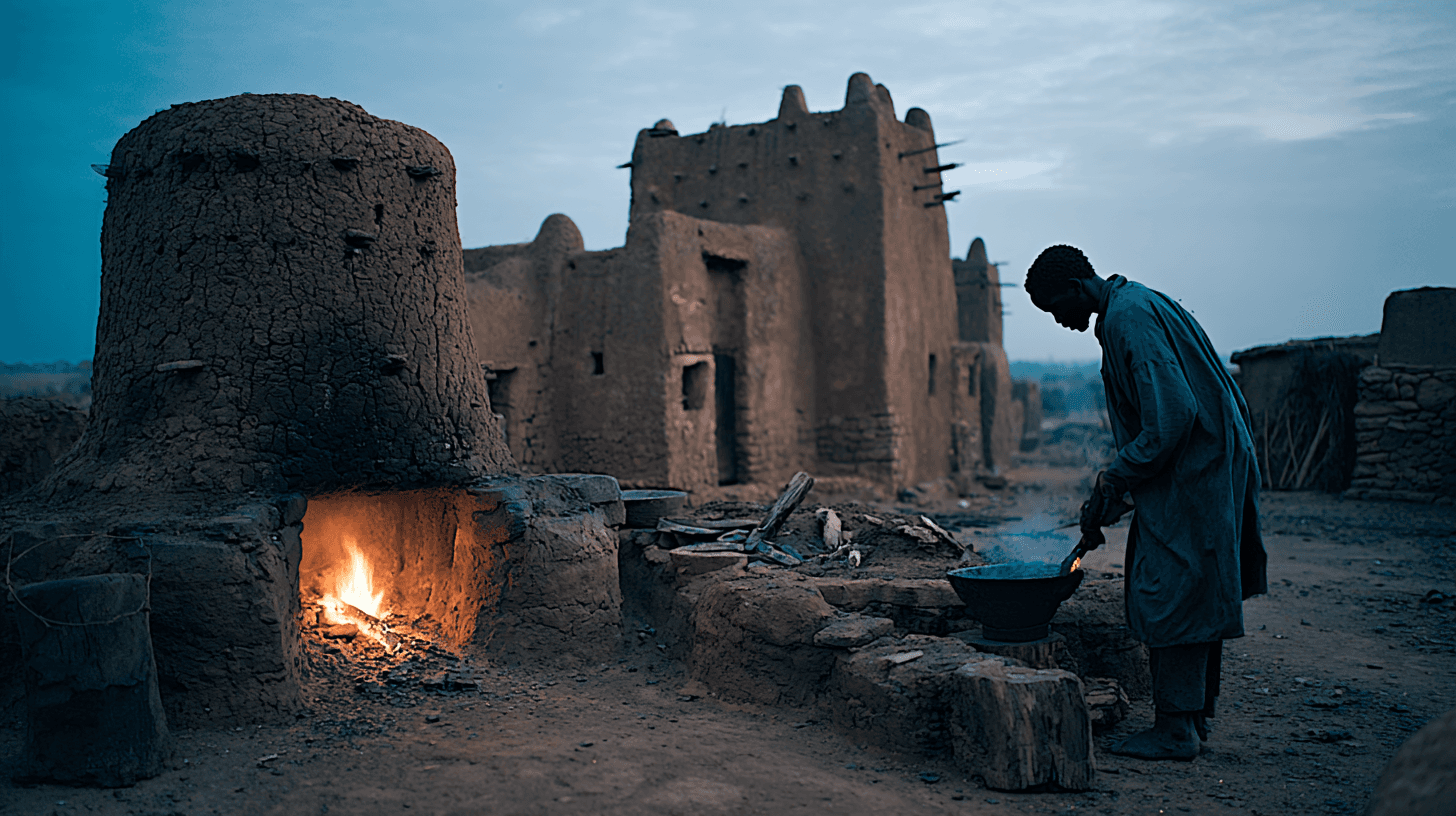
An African bloomery furnace is a chimney of clay, packed with iron ore and charcoal, heated by air pumped through bellows. The temperature inside exceeds 1,200 degrees Celsius — hot enough to reduce the ore to metal, to burn away impurities, to produce a spongy mass of iron called a bloom.
The technology sounds simple. It is not. The ore must be selected correctly. The charcoal must be prepared properly. The furnace must be built to the right dimensions. The bellows must deliver air at the right rate. The temperature must be maintained for hours. A mistake at any stage produces slag, not iron.
The knowledge required is extensive. It is also empirical — developed through generations of experiment and observation, refined without scientific theory, transmitted through apprenticeship and practice. The smiths who mastered it were technologists, even if their culture did not use that word.
Some African furnaces achieved something European metallurgy could not: the direct production of steel. By controlling temperature and carbon content, smiths in Tanzania and elsewhere produced carbon steel in a single operation. European technology required multiple steps and did not achieve reliable steel production until the industrial era.
The Smiths
Iron smiths in traditional African societies occupied a special position. They were respected and feared, associated with transformative power, sometimes set apart from ordinary social categories. The ability to turn rock into metal was understood as a kind of magic — not supernatural, but not ordinary either.
The knowledge was secret. Smelting techniques were closely guarded, passed from father to son or from master to chosen apprentice. The secrecy was partly economic — monopoly protected income — and partly spiritual. The power to make iron was not shared lightly.
This secrecy preserved the knowledge through colonialism. European administrators dismissed African metallurgy as primitive, but they did not destroy it because they did not understand it. The smiths continued their work, adapting to new conditions, keeping their furnaces burning even as imported iron flooded the markets.
The Decline
Imported iron killed the traditional industry. European and later Asian manufacturers could produce iron and steel more cheaply than African furnaces. The economics were unanswerable. Why spend days smelting ore when you could buy metal in the market for less than the cost of charcoal?
The furnaces went cold. The knowledge that had accumulated over 3,000 years began to fade. The young men who might have become smiths found other work. The masters aged and died, taking their secrets with them.
By the late 20th century, traditional iron smelting had nearly vanished. A handful of communities continued the practice, mostly for ceremonial purposes. The technology that had made the Iron Age African was remembered by a few dozen elderly men, most of whom had not lit a furnace in decades.
The Revival
Archaeologists began documenting what remained. They found smiths who remembered the techniques, who could build furnaces and produce iron, who held knowledge that no book had ever recorded. The documentation was urgent — the masters were dying, and with each death, irreplaceable knowledge was lost.
Some communities began practicing again. The revival was partly cultural — a reclaiming of heritage that colonialism had dismissed. It was partly economic — traditional iron objects had value as art and artifact. It was partly scientific — archaeologists and metallurgists wanted to understand what the furnaces could do.
The revival is small. Perhaps a few dozen smiths worldwide can still produce iron the traditional way. The technology will not displace industrial production. But the knowledge survives — proof that African metallurgy was real, was sophisticated, was independent of European influence.
What Remains
The furnaces can still be built. The ore can still be smelted. The bloom can still be forged into tools and weapons. The technology that developed 3,000 years ago still works, still produces iron, still demonstrates what African smiths achieved before Europe knew Africa existed.
What remains is more than technique. It is a counter-narrative, a correction to stories that denied African technological achievement. The furnaces prove that metallurgy was not a gift from elsewhere. It was developed here, independently, by people who figured out how to turn rock into metal on their own terms.
The smiths who still practice are the last links to this tradition. They know things that no one else knows, techniques that were old when Rome was young, secrets that were kept for three millennia and are now being shared with anthropologists and archaeologists before they are lost forever.
The iron comes from the earth. The knowledge comes from generations who are mostly gone. The furnaces still burn, in a few places, for a few more years, producing metal that connects the present to a past that was almost forgotten.
African iron. African technology. African knowledge, refusing to disappear.
Sources
- Schmidt P. and Avery D. (1978). Complex Iron Smelting and Prehistoric Culture in Tanzania
- Childs S.T. and Killick D. (1993). Indigenous African Metallurgy
- Cline W. (1937). Mining and Metallurgy in Negro Africa
- Haaland R. (2004). The Emergence of Iron Smelting in Africa