Systems
The Indigo Vats
The blue that takes a year to make
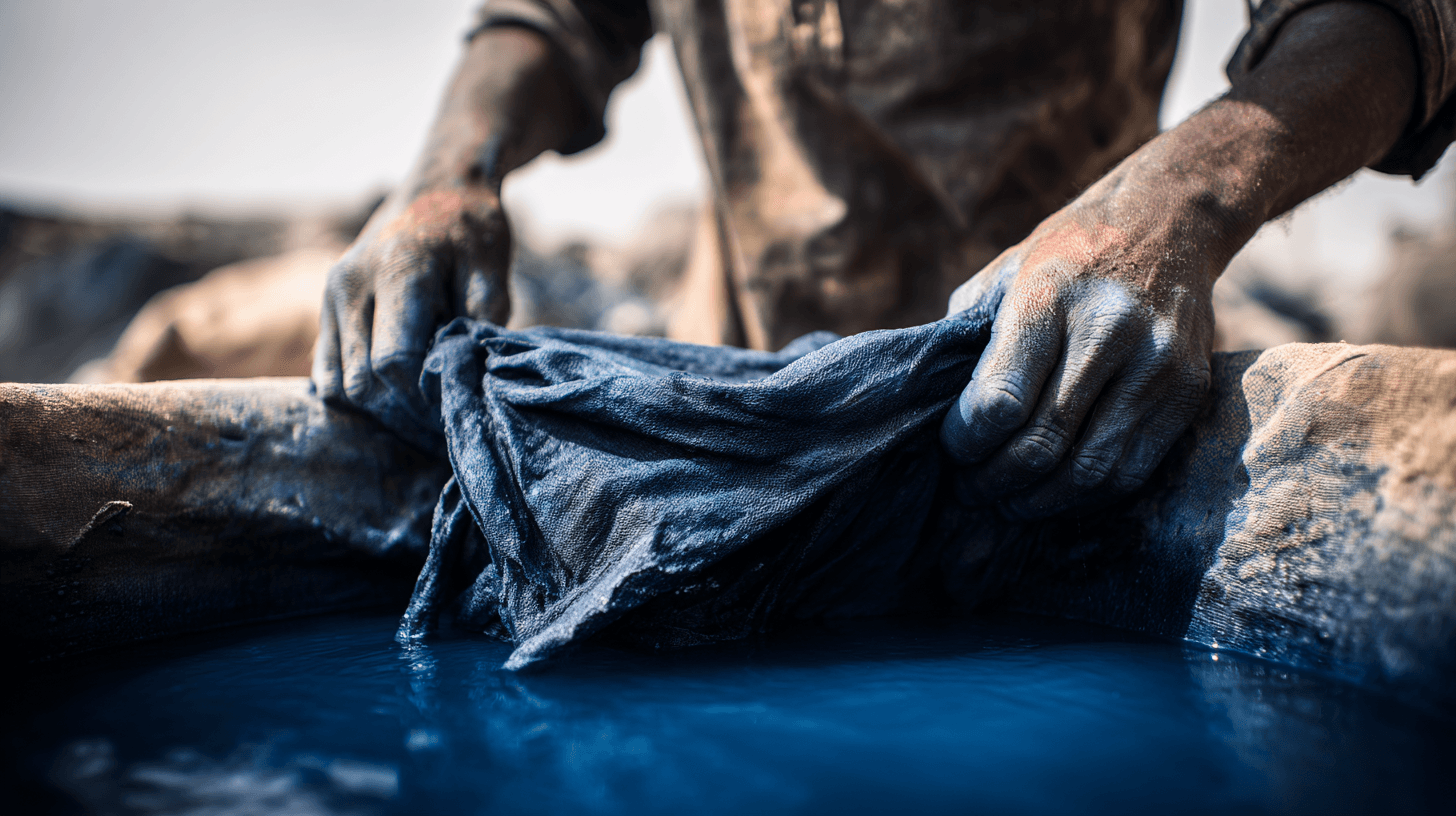
The cloth goes in white. It comes out pale green, dripping with the fermented dye. The dyer lifts it to the air and waits. The transformation takes seconds: green darkens to teal, teal deepens to blue, blue intensifies until it seems to swallow light.
In the dye pits of Kano, Nigeria, this alchemy has continued for five hundred years.
The pits are still there, still producing, still using techniques that have not fundamentally changed in half a millennium.
The Vats
The dye pits are circular holes dug into the earth, lined with clay, and filled with a fermenting solution of indigo, ash, and water. The vats are alive — the dyeing process depends on bacterial fermentation that reduces the indigo to a soluble form. The chemistry is complex; the practice is older than the chemistry.
A new vat takes years to mature. The mixture must ferment, the bacterial cultures must establish themselves, the balance of ingredients must stabilize. A mature vat — one that produces the deepest, most colorfast blue — may be 50 or 100 years old. Some vats in Kano have been in continuous use for centuries.
The dyers feed their vats the way farmers feed their livestock. Wood ash to maintain alkalinity. Dates or honey to feed the bacteria. Urine — traditionally collected from the community — to provide ammonia. The recipe is traditional, the ingredients local, the knowledge passed from master to apprentice.
The Process
Dyeing with indigo is counterintuitive. The cloth goes into the vat white. It comes out looking green. Only when it is exposed to air does the color change, oxidizing from greenish-yellow to blue before your eyes. The chemistry is magical; the first time you see it happen, you understand why indigo was precious.
Deep color requires repeated dipping. The cloth is submerged, removed, aired, and submerged again — 10 times, 20 times, 50 times for the darkest shades. Each dipping adds another layer of color. The deepest blue, almost black, takes weeks of patient repetition.
The dyers know by sight when the vat is ready, when the cloth has absorbed enough, when the color will be true. They know by smell whether the fermentation is healthy. They know by touch whether the cloth is taking the dye evenly. The knowledge is sensory, built over years of practice.
The Trade
Kano cloth was currency. Before European colonization, the indigo-dyed cotton of Kano circulated across West Africa as a medium of exchange. Its value was recognized from Timbuktu to the coast. The production of this cloth — and the control of the dye pits that made it — was a source of political power.
The trade shaped the city. Kano's old quarter is organized around the dye pits, with neighborhoods for weavers, for dyers, for merchants who bought and sold the finished cloth. The social structure of the city reflects the organization of the industry.
Colonization and industrialization disrupted the trade. Synthetic indigo, developed in Germany in the late 19th century, undercut natural dye. Mass-produced cloth from European factories undercut local weavers. The market for Kano cloth contracted from international commerce to regional specialty.
The Survival
The dye pits survived because they produced something factories could not replicate. Synthetic indigo is chemically identical to natural indigo, but the process is different. Industrial dyeing is fast, standardized, consistent. Kano dyeing is slow, variable, deep.
The difference shows in the cloth. Industrial indigo sits on the surface; Kano indigo penetrates the fiber. Industrial indigo is uniform; Kano indigo has depth and variation. The blue is different — richer, more alive, impossible to counterfeit.
This difference became a selling point. As mass production made cloth generic, handcrafted cloth became valuable precisely because it was not generic. Kano indigo found markets among collectors, designers, and museums. The same characteristics that made it obsolete in industrial terms made it precious in craft terms.
The Future
The pits are UNESCO-recognized heritage. Tourists visit to watch the dyers work. Fashion houses commission cloth for high-end collections. The tradition has found new economic footing.
But the economics are fragile. The work is hard, the returns uncertain, the next generation not necessarily interested. Some dyers have sons who choose other professions. Some vats that have fermented for generations have been filled in and built over.
What cannot be rebuilt is the bacterial culture in a century-old vat. What cannot be taught in a workshop is the knowledge that takes a lifetime to accumulate. The tradition depends on continuity — on young people choosing to do what their fathers and grandfathers did, on mature vats being maintained rather than abandoned.
What Remains
The cloth still comes out of the vats blue. The color still deepens with each dipping. The blue is still the blue that crossed the Sahara 500 years ago.
The vats are living things — fermentation tanks populated by bacterial cultures that have been maintained for generations. They are industrial heritage, craft tradition, and biological systems all at once. They produce color by processes that modern chemistry can explain but not improve upon.
In the old quarter of Kano, the dyers still descend into the pits. They still feed the vats. They still produce the blue that made the city wealthy and famous and worth crossing the desert to reach.
The vats require care. The tradition requires transmission. The blue requires patience.
These things have been true for 500 years. Whether they will be true for 500 more depends on decisions being made now, in a city that has many concerns and many opportunities and only so much attention for its ancient pits.
Sources
- Shea P. (2006). Big is Sometimes Best: The Kano Cloth Industry
- Kriger C. (2006). Cloth in West African History
- Balfour-Paul J. (2011). Indigo: Egyptian Mummies to Blue Jeans
- Picton J. and Mack J. (1989). African Textiles