Systems
The Ice Stupas
Glaciers built by hand
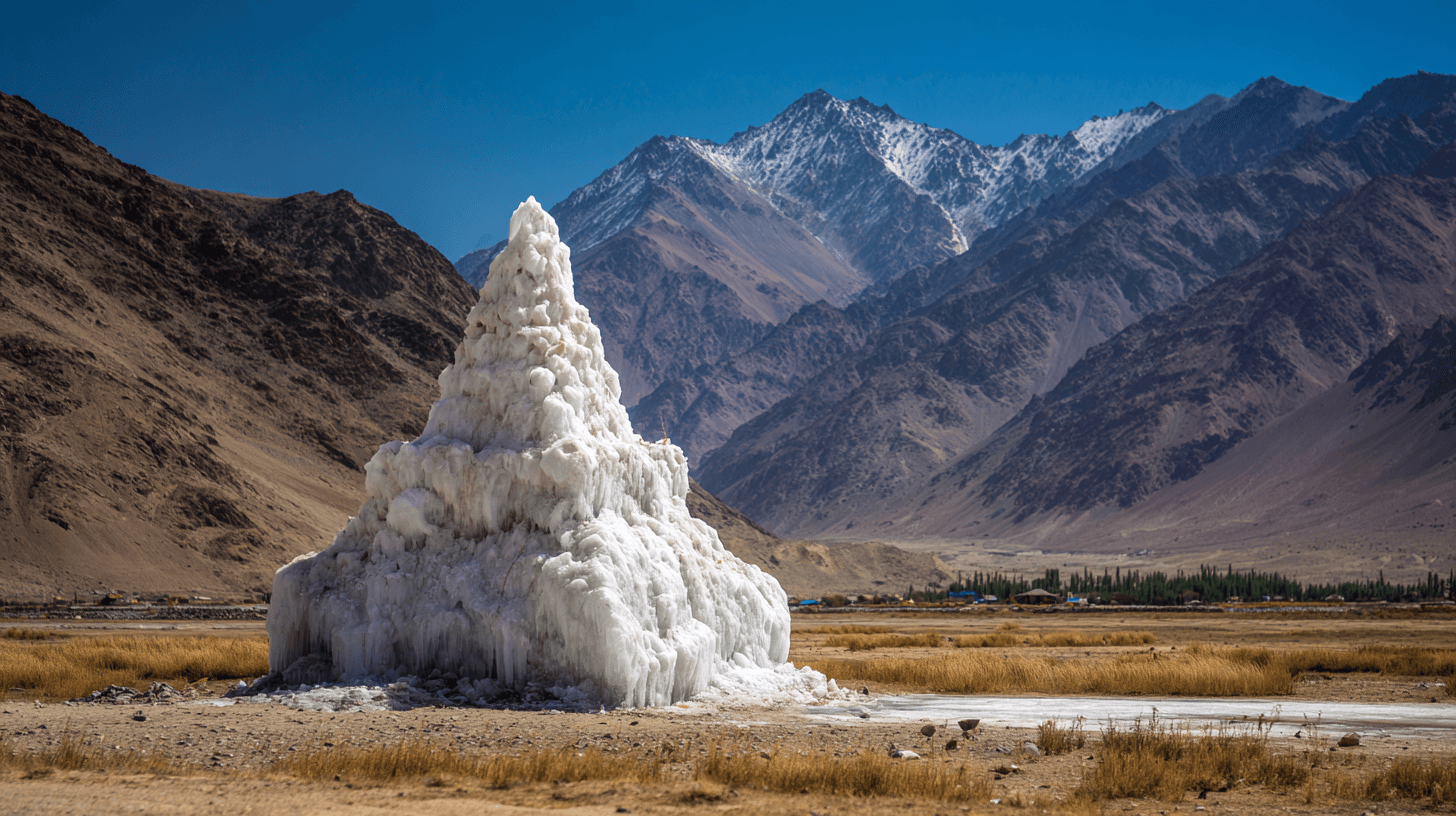
The towers of ice appear each winter, thirty meters tall. By summer, they're gone — melted into irrigation canals when the farmers need water most.
The ice stupa is a technology for time-shifting water. Winter has plenty of water; summer has none. The stupas store the excess.
The Problem
Ladakh sits in the rain shadow of the Himalayas. Annual rainfall: approximately 100 millimeters — less than the Sahara in some areas. Agriculture depends entirely on glacial melt.
The glaciers are receding. Snow that used to fall in winter is falling as rain and running off immediately. The seasonal timing is shifting. Spring planting requires water that arrives too early or not at all.
The Solution
Sonam Wangchuk is an engineer from Ladakh. He noticed that ice patches in shaded areas persisted well into summer. If natural shade could preserve ice, maybe artificial shade could too.
The ice stupa works by spraying water in a thin stream that freezes as it falls. The cone shape — like a Buddhist stupa — minimizes surface area exposed to sun while maximizing volume. The ice lasts months into spring.
The Numbers
A single ice stupa can store 150,000 liters of water. The project has built dozens across Ladakh. The water released during spring melting irrigates crops that would otherwise fail.
The technology costs roughly $1,500 per stupa. Materials are local. Maintenance is minimal. Villages can build and operate them independently.
The Physics
Water flows downhill through pipes from sources at higher elevations. At the stupa site, it sprays upward. The spray freezes in the cold night air and accumulates into a cone.
The cone shape is thermodynamically efficient. Less surface area means slower melting. The pointed top shades the base. The shape was inspired by Buddhist architecture, but the benefits are pure physics.
The Spread
The ice stupa model has been replicated in Switzerland, Chile, Peru — anywhere glacial retreat threatens water supply. The technology requires cold winters and sunny summers. Within those constraints, it works.
What started as one engineer's experiment in a Himalayan village has become a global adaptation strategy.
The Limits
Ice stupas don't fix climate change. They buffer one consequence of it. If temperatures rise enough, even stupas won't freeze. If snowfall patterns shift dramatically, there's no winter water to store.
This is a bridge technology — something that buys time while larger changes happen or don't.
The Image
The stupas are beautiful. White pyramids against brown desert mountains. They look like religious monuments, which is intentional — the shape invites respect.
They are also functional objects that will not exist by summer. Their disappearance is the point. The water goes where it needs to go.
Temporary infrastructure. Designed obsolescence. The opposite of permanence, but permanent in its effects.
Sources
- Wangchuk S. (2017). Ice Stupa Artificial Glaciers of Ladakh
- Nusser M. et al. (2019). Artificial Glaciers as an Adaptation Strategy
- HIAL (Himalayan Institute of Alternatives) Technical Reports
- Clouse C. (2020). Frozen Rivers: Seeking the Ice Stupa