Systems
The Ice Harvesters
The cold that crossed oceans
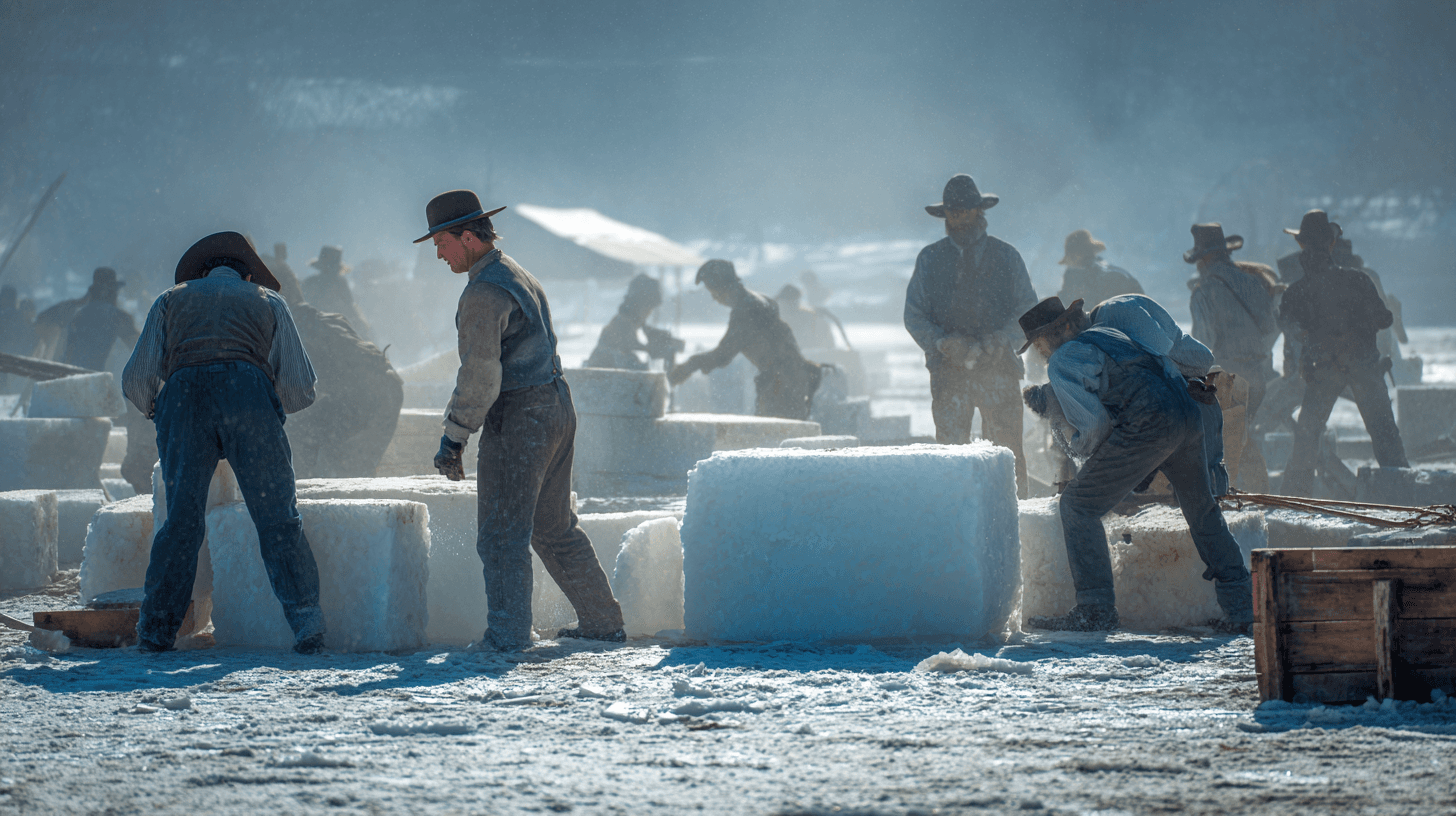
The saw bites into the frozen lake. Block by block, the ice is cut free, lifted with tongs, loaded onto sledges. It will be packed in sawdust, stored in stone buildings, shipped across oceans — arriving months later, still frozen, in places that have never seen winter.
Before refrigeration, this is how summer stayed cold.
New England was the center. The lakes of Maine, Massachusetts, and New Hampshire froze thick and clear each winter. The ice was cut, stored, and shipped to cities along the Atlantic coast, to the Caribbean, to India and China. By the 1850s, ice was America's second-largest export after cotton. The frozen water of New England cooled the world.
Mechanical refrigeration killed the trade. By the early 20th century, ice factories produced cleaner ice more cheaply than nature. The harvesting stopped. The ice houses rotted. The skills were forgotten.
Almost forgotten. A handful of ice harvesters still work, demonstrating at fairs and festivals, maintaining knowledge that once supported an industry.
The Harvest
Ice harvesting was industrial-scale farming of a strange crop. The work began when lakes froze thick enough to support men and horses — usually in January, when ice reached 12 to 18 inches. Teams cleared the snow, scored the surface into grids, and cut blocks using horse-drawn or steam-powered saws.
The blocks were uniform — typically 22 inches square and 10 to 12 inches thick — sized to stack efficiently in ice houses and ship's holds. Consistency mattered. Irregular blocks wasted space and melted faster. The industry developed tools and techniques to produce standardized product from the chaos of frozen lakes.
The cut blocks were floated to ramps where workers guided them into ice houses — vast insulated barns that held thousands of tons. The blocks were stacked with sawdust between layers, which insulated them enough to preserve the ice through summer and into fall. A well-built ice house lost only 10 to 20 percent of its contents to melting over a year.
The work was dangerous and exhausting. Men worked on frozen lakes in bitter cold, handling tools that could kill. Horses sometimes broke through thin ice. Workers fell into channels between blocks. The cold was relentless. The season was short, and every day counted.
The Trade
Frederic Tudor of Boston created the ice trade in 1806, shipping ice to Martinique on a speculation that his contemporaries thought insane. The first shipment failed — the ice melted, the buyers were skeptical, Tudor nearly went bankrupt. He persisted. By the 1830s, Tudor's ice was reaching Calcutta.
The trade grew because demand was everywhere. In the days before refrigeration, ice was the only way to preserve food, cool drinks, reduce fevers. The wealthy had always had access to ice, stored from winter in private ice houses. The Tudor trade made ice available to anyone who could pay.
The logistics were remarkable. Ice could survive for months in transit if properly insulated. Ships carried ice to ports where temperatures never dropped below freezing, sold it for prices that covered the journey, and returned with cargo that made the trip profitable in both directions. The trade integrated distant economies through the movement of frozen water.
At its peak, the ice trade employed thousands of workers and supported hundreds of companies. Entire towns depended on the winter harvest. The ice that left Maine cooled hospitals in New Orleans, preserved fish in Charleston, chilled champagne in Havana. The industry seemed permanent.
The End
Carl von Linde's compression refrigeration system, perfected in the 1870s, made ice anywhere. Factories could produce ice in any climate, in any season, without the uncertainty of weather or the expense of long-distance transport. The advantages were overwhelming.
The natural ice industry fought back. Advocates argued that natural ice was purer, that factory ice tasted wrong, that the old ways were better. They were wrong on every point, but the arguments bought time. The industry lingered into the 20th century before finally collapsing.
By the 1920s, harvesting had essentially ended. The ice houses were torn down or abandoned. The tools were scrapped. The workers found other employment. The industry that had seemed essential disappeared so completely that most people today do not know it existed.
What Remains
A handful of enthusiasts maintain the old skills. They harvest ice by hand at winter festivals, demonstrating tools and techniques that their ancestors used for livelihood. The work is now educational entertainment, preserving knowledge that has no commercial value.
The demonstrations are authentic. The ice is real, cut from frozen ponds with hand saws and horse-drawn plows. The workers know what they are doing — the angle of the saw, the thickness of the cut, the way to guide a block up the ramp. The skills survive because someone chose to learn them.
Some ice houses survive as well, converted to other uses or preserved as museums. They are massive structures, built for a purpose that no longer exists, monuments to an industry that once employed armies. The scale is impressive even empty.
The trade itself left marks on the landscape. The channels cut for floating blocks are still visible on some lakes. The foundations of ice houses dot the shores of New England ponds. The infrastructure of an industry that shaped world commerce for a century remains, barely visible, waiting for someone to notice.
Ice is everywhere now, produced in every kitchen, available in every store, so common that its absence is inconceivable. The abundance erases the memory of scarcity. The idea that frozen water was once precious, once shipped across oceans, once built fortunes — this idea requires imagination that comes hard to people who have never lived without refrigeration.
The harvesters remember. At their demonstrations, on frozen lakes in January, they cut blocks as their great-great-grandfathers did. The ice is still cold. The work is still hard. The skill is still real. Only the purpose has changed.
Sources
- Weightman G. (2003). The Frozen-Water Trade
- Cummings R. (1949). The American Ice Harvests
- Tudor F. (1849). The Ice King: Frederic Tudor and His Circle
- Anderson O. (1953). Refrigeration in America