Systems
The Glacier Watchers
The ice that tells time
For 400 years, scientists and villagers have measured the Mer de Glace. The records they created are now invaluable — a timeline of climate change written in ice and ink.
The Mer de Glace — the Sea of Ice — is the largest glacier in France. It flows down from the slopes of Mont Blanc, a river of ice 7 kilometers long and up to 200 meters deep. It has been studied, painted, photographed, and measured since the 17th century. It is one of the best-documented glaciers on earth.
The documentation began as curiosity. Scientists and travelers came to marvel at the ice, to understand it, to record what they saw. Over centuries, their observations accumulated into something more valuable than any individual could have imagined: a continuous record of how a glacier has changed over 400 years.
That record now tells us what is happening to the climate. The Mer de Glace is a thermometer, and we have been reading it longer than almost any other.
The Record
The first known measurements of the Mer de Glace date to the early 17th century. Local records document the glacier's advance into the valley, destroying farms and buildings, forcing villagers to petition the bishop for prayers against the ice. The Little Ice Age was at its peak. The glacier was growing.
By the 18th century, scientists were visiting regularly. They made drawings, took measurements, noted the position of the glacier's terminus relative to fixed landmarks. The records were not systematic by modern standards, but they were records — data points that could be compared across decades and centuries.
The 19th century brought photography. The earliest photographs of the Mer de Glace, from the 1850s, show an ice mass dramatically larger than today's. The images can be compared directly with modern photographs taken from the same positions. The shrinkage is visible, undeniable, measurable.
The 20th century brought scientific rigor. Regular measurements of ice thickness, flow rate, and terminus position created continuous datasets. The Laboratoire de Glaciologie in Grenoble compiled records going back centuries. The Mer de Glace became a reference glacier, its behavior used to understand ice dynamics worldwide.
The Change
The glacier is shrinking. This is not subtle or debatable. The terminus has retreated over 2 kilometers since 1850. The surface has dropped more than 150 meters in some areas. The ice that took centuries to accumulate is disappearing in decades.
The rate of loss is accelerating. In the 19th century, the glacier retreated slowly. In the early 20th century, it stabilized and even advanced slightly. Since the 1980s, the retreat has accelerated dramatically. The glacier is now losing 4 to 5 meters of thickness per year.
The visitors see the change directly. A staircase cut into the rock leads down to an ice grotto carved into the glacier. Each year, more stairs must be added as the surface drops. Signs mark the ice level in previous years. The descent grows longer annually. The timeline is literal.
Climate scientists use the Mer de Glace record to calibrate their models. A dataset spanning 400 years is rare. It provides context that shorter records cannot — showing that the current retreat is unprecedented in the period of observation, that the glacier behaved differently before industrialization, that what is happening now is new.
The Watchers
The glacier has always had watchers. The early scientists came for curiosity. The artists came for beauty. The mountaineers came for challenge. Each group left records, observations, data that accumulated into the archive that now exists.
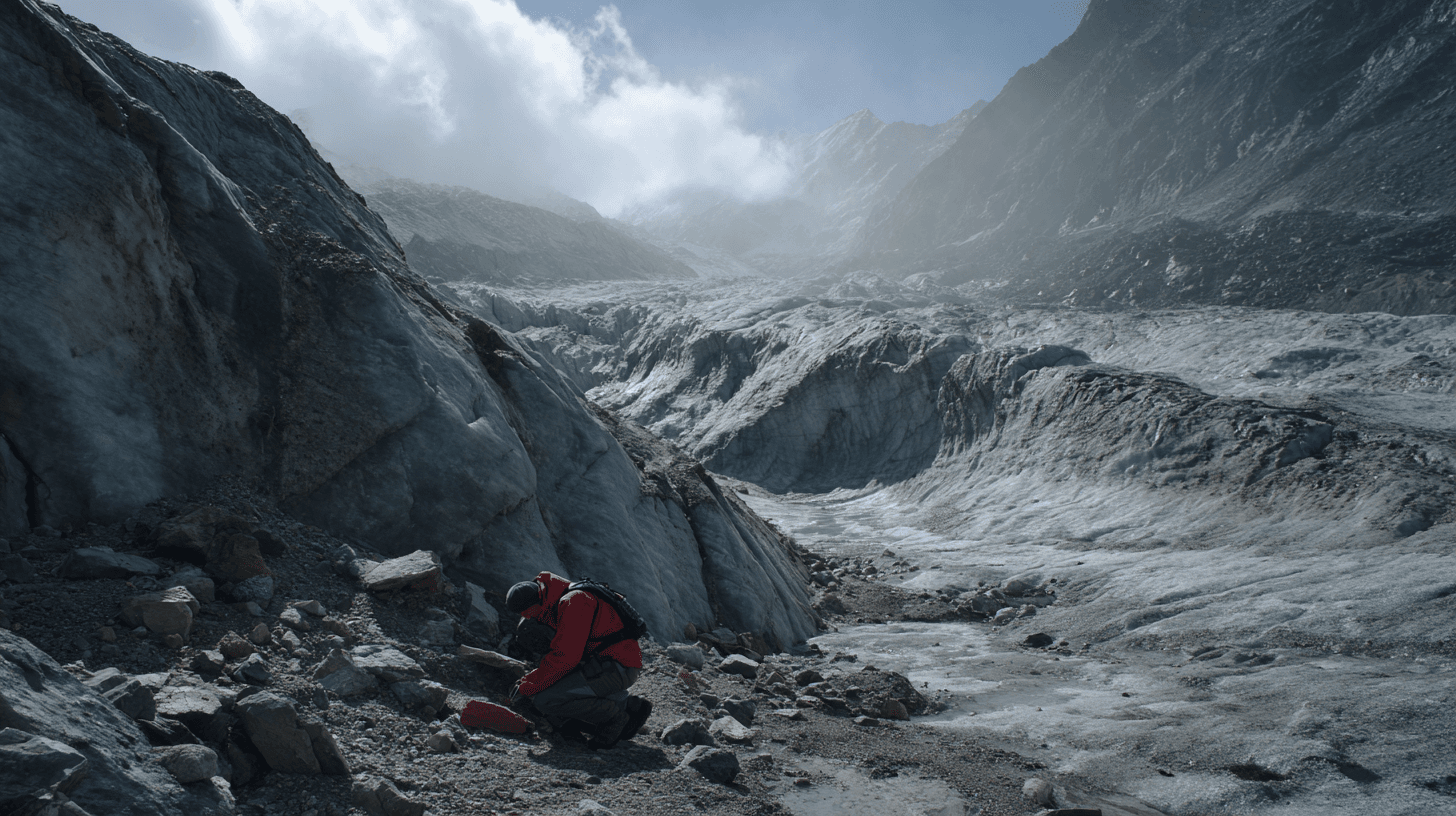
The modern watchers are glaciologists, employed by research institutions, equipped with instruments their predecessors could not imagine. They measure ice thickness with radar. They track flow with GPS. They monitor temperature, precipitation, and albedo with automated sensors. The data flows continuously.
But they also continue the older work. Photographs are taken from historical vantage points, replicating images made a century ago. Terminus positions are surveyed with precision that the 19th-century observers would recognize. The new methods supplement but do not replace the old ones. Continuity matters.
The villagers watch too. The people of Chamonix have lived with the glacier for centuries. They remember when the ice was closer, when the winter was colder, when the world was different. Their memories are not data in the scientific sense, but they are knowledge. They are part of the record.
The Future
The Mer de Glace will continue to shrink. Climate models project substantial ice loss by mid-century, potentially transforming the glacier into a fraction of its current size. The sea of ice may become a pond.
The record will continue too. The measurements will document what happens, creating data that future scientists will use to understand what we did to the climate and how the ice responded. The Mer de Glace will be a case study, a reference point, a warning.
The watchers will continue as well. Scientists will measure. Tourists will descend the lengthening stairs. Villagers will remember what was. The glacier that has been watched for 400 years will be watched as it disappears, its death documented as carefully as its life.
What Remains
The ice remains, for now. Reduced, retreating, but still there — still flowing down from Mont Blanc, still carving its valley, still blue and white and cold. The Mer de Glace is still a glacier, still impressive, still worth watching.
The record remains. Four centuries of observations, measurements, images, and notes — a dataset of extraordinary value, created by accident and accumulated by persistence. The record tells us what we have done. It tells us what we are losing. It tells us what remains.
The watchers remain. The scientists with their instruments. The tourists with their cameras. The villagers with their memories. They continue to observe, to document, to bear witness to a transformation that they did not cause and cannot stop.
The glacier is a timeline. It tells us where we have been and where we are going. It tells us in ice, which is melting, and in records, which endure. The story it tells is not comfortable. But it is true, and it has been told for 400 years, and it will continue to be told as long as anyone is watching.
The watchers are still there. The ice is still there. For now.
Sources
- Vincent C. et al. (2014). The Mer de Glace: A reference glacier
- Le Roy M. et al. (2015). Calendar-dated glacier variations in the western European Alps during the Neoglacial
- Nussbaumer S. and Zumbühl H. (2012). The Little Ice Age history of the Glacier des Bossons
- Mougin P. (1912). Études glaciologiques