Systems
The Floating Gardens
The farms that float
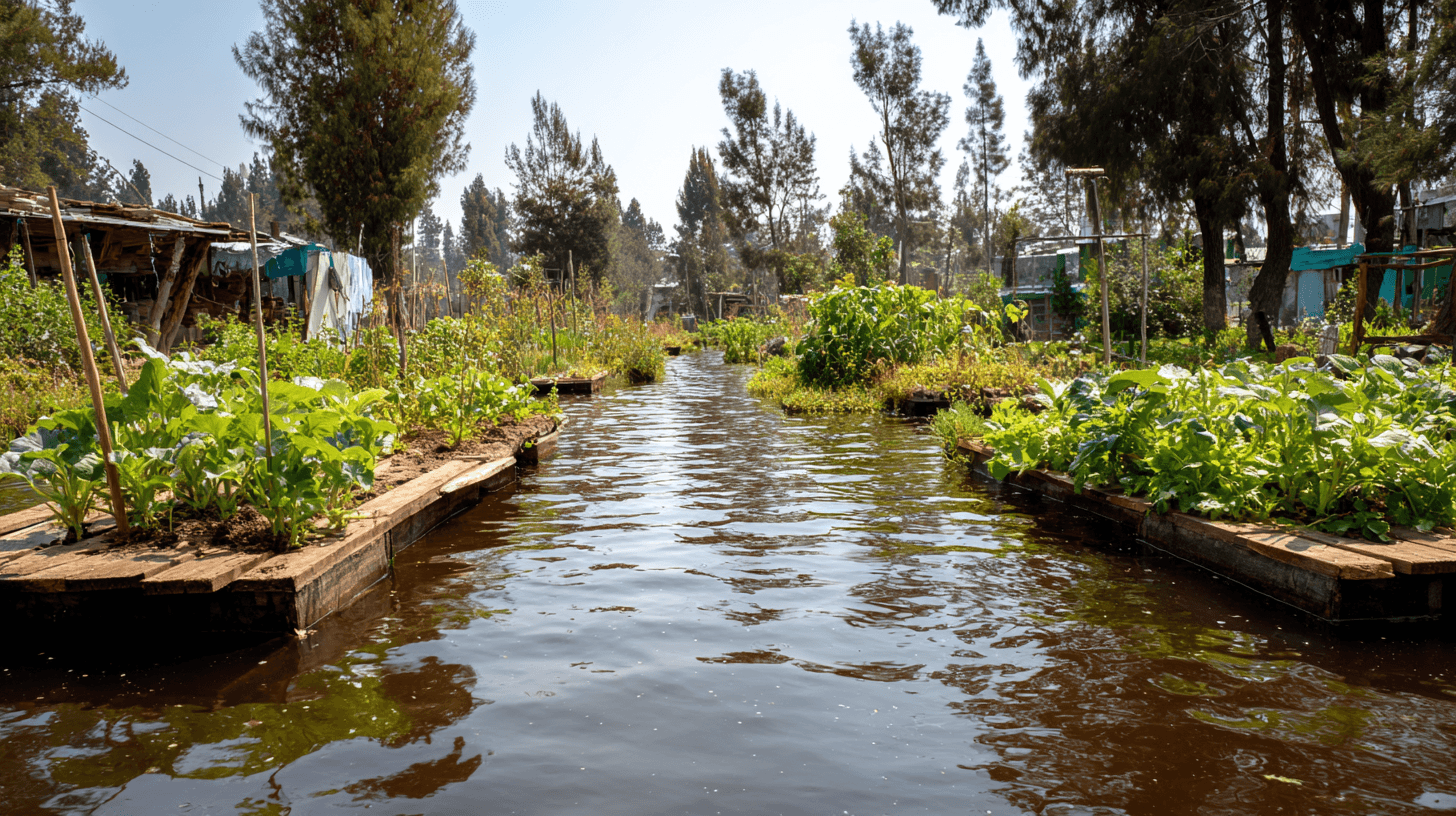
The gardens float on water. Not literally — they're anchored by roots that reach down through the mat of vegetation into the lake bed below. But the surface is buoyant enough to walk on, to farm on, to build small structures on.
The Aztecs built these chinampas. Mexico City's farmers still work them.
So they built land. They drove stakes into the shallow lake bed, wove them with branches, and piled mud and vegetation on top until they had islands. On the islands they planted crops. The system worked so well that within two centuries, the Aztec capital of Tenochtitlan was one of the largest cities in the world, fed by thousands of floating gardens.
The Spanish destroyed Tenochtitlan. They drained most of the lake. But in Xochimilco, at the southern edge of what is now Mexico City, the gardens survived. They are still there, still farmed, still producing vegetables for the markets of the capital.
The Chinampas
A chinampa is not exactly a floating island. It is anchored to the lake bed by the roots of willow trees planted at its edges. But it is not exactly solid ground either. The soil is lake-bottom mud, perpetually moist, continuously fertilized by the water around it.
The productivity is extraordinary. A chinampa can be planted year-round — there is no winter in central Mexico, and the water moderates temperature extremes. The soil never dries out. The nutrients in the lake water replenish what the crops remove. A single hectare of chinampa can produce four to seven harvests per year.
Before the Green Revolution, before chemical fertilizers and industrial irrigation, the chinampas of Xochimilco were among the most productive agricultural lands on earth. They fed the Aztec empire. They fed colonial Mexico City. They still feed the 21 million people of the modern metropolis.
The System
Chinampa agriculture is not just a technique. It is a system — an integrated approach that manages water, soil, and crops together.
The canals between the chinampas are not just transportation routes. They are fish habitat, providing protein to supplement the vegetable crops. They are water sources for irrigation during dry periods. They are temperature regulators, absorbing heat during the day and releasing it at night.
The willow trees at the edges are not just anchors. Their roots filter the water. Their leaves provide mulch. Their branches are harvested for stakes and baskets. Everything serves multiple purposes.
The farmers who work the chinampas understand these connections. They know how to read the water, when to dredge the canals, how to balance crops to maintain soil fertility. The knowledge is not written in textbooks. It is held in practice, passed from parents to children, tested against the reality of production.
The Threat
Mexico City is killing the chinampas. The metropolis has grown to surround Xochimilco, drawing water from aquifers that once fed the lake. The water level is dropping. The canals are shrinking. Some chinampas that once floated now rest on dry ground.
Pollution is equally damaging. Urban runoff carries sewage, chemicals, and garbage into the canals. The water that once nourished crops now poisons them. Farmers who used to drink from the canals now must bring water from elsewhere.
Urban expansion claims land. Developers offer prices that farmers cannot refuse. Chinampas that produced food for centuries become housing developments, shopping centers, parking lots. The agricultural zone shrinks year by year.
And the economics no longer work. A farmer growing vegetables on a chinampa competes with industrial agriculture that can produce more cheaply. The labor is hard, the returns modest, the young people uninterested. The average chinampa farmer is over 60 years old.
The Resistance
Some farmers are fighting back. Organic certification allows them to charge premium prices. Tourism brings visitors who pay to see the traditional farms. Restaurants in Mexico City feature chinampa vegetables as local delicacies.
Conservation organizations have established protected areas. The Mexican government has designated the chinampas as a UNESCO World Heritage site. International attention has brought funding for restoration and research.
The axolotl — the strange salamander native to Xochimilco — has become a symbol of both crisis and hope. The species is critically endangered, surviving only in the canal system. Efforts to save the axolotl necessarily involve saving the chinampas. The salamander and the farms depend on each other.
What Remains
The chinampas are still there. Reduced, degraded, threatened, but still there. Farmers still pole their boats through the canals. Vegetables still grow in the lake-bottom mud. The system that fed the Aztec empire still produces food for Mexico City.
What remains is fragile. The water is lower than it was. The canals are narrower. The farmers are older. The pressures are intensifying.
But 700 years is a long time. The chinampas survived the conquest, survived colonialism, survived the draining of the lake, survived the growth of one of the world's largest cities around them. They have proven more durable than the civilizations that built them.
Whether they will survive the next generation is uncertain. But they have survived everything so far. The farms float on. The crops grow. The ancient system continues to do what it was designed to do.
Sources
- Morehart C. (2016). Chinampa Agriculture, Surplus Production, and Political Change
- Rojas T. (1993). La Agricultura Chinampera
- UNESCO World Heritage: Historic Centre of Mexico City and Xochimilco
- Merlín-Uribe Y. et al. (2013). Environmental and socio-economic sustainability of chinampas