Systems
The Felt Makers
The fabric that built empires
No loom. No spindle. Just wool, hot water, and hours of rolling.
Felt is textile's oldest form — fiber matted together through heat, moisture, and agitation. The scales on wool fibers interlock permanently. What starts as loose fleece becomes solid fabric.
In Kyrgyzstan, felt isn't heritage. It's infrastructure.
The Function
Yurts are insulated with felt. The nomadic dwelling that has housed Central Asian peoples for millennia depends on felt walls, felt floors, felt doors. Without felt, the yurt doesn't work.
This is not tourism. This is housing. The felt must be made because it's needed.
The Process
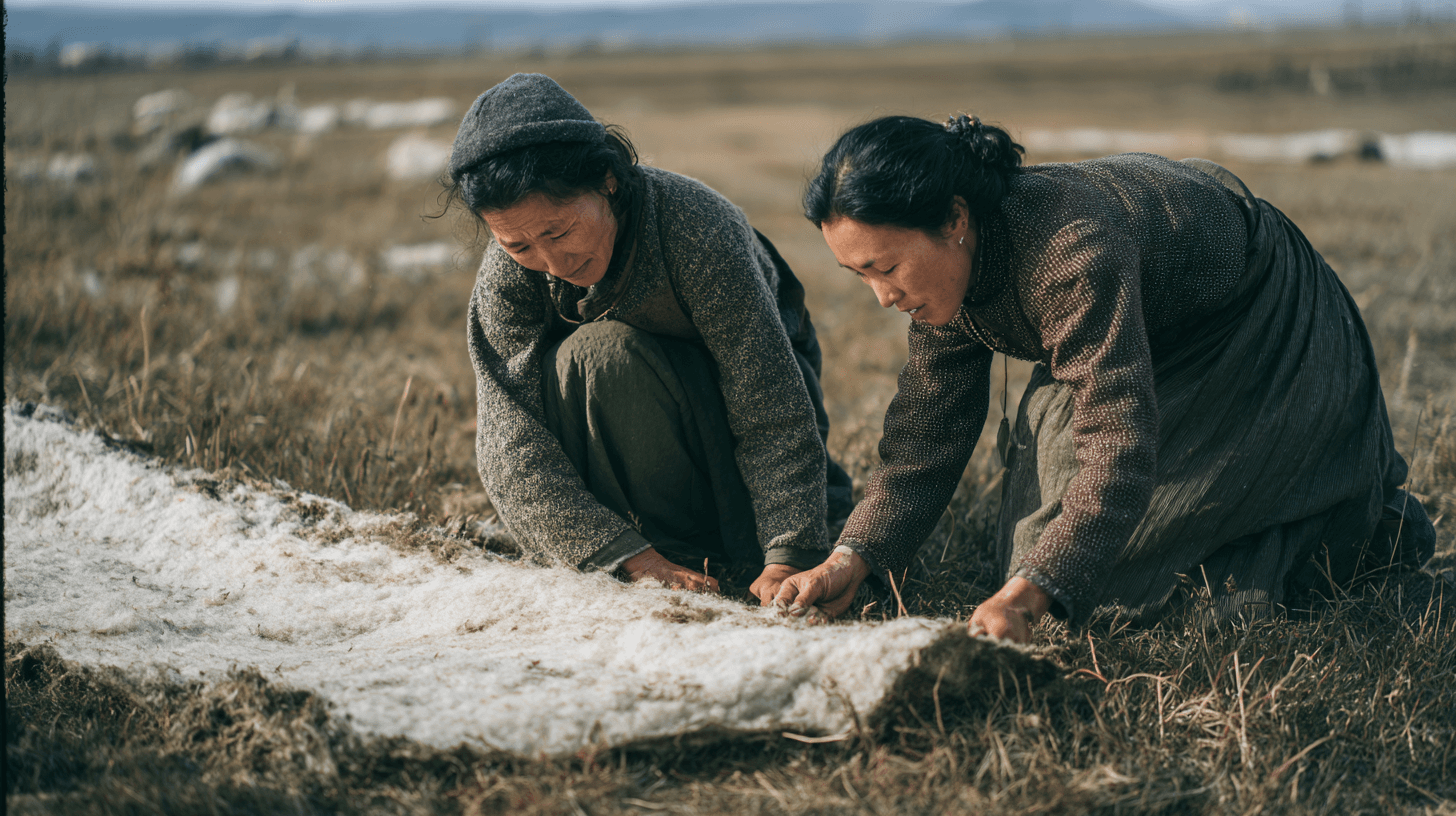
Fleece is laid out on a reed mat in layers, building up thickness. Hot water is poured. Then the mat is rolled around a pole and rolled — back and forth, hundreds of times, for hours.
The physical labor is substantial. Traditional making is communal; neighbors help each other because the work requires many hands.
The Patterns
Shyrdak felt rugs carry specific designs — spiral horns, geometric borders, interlocking elements. Each region has characteristic patterns. Each maker has individual style within regional conventions.
The designs are created by layering different colored wools before felting, or by cutting and inlaying colored pieces afterward. Both techniques require planning — the design must be set before the felting begins.
The Economics
Machine-made felt exists. It's uniform, cheap, industrially produced. It works for industrial applications.
For yurt insulation, handmade felt has advantages: variable thickness where needed, traditional sizing, the social process of making. Machine felt doesn't substitute completely.
The market for decorative shyrdak extends beyond Central Asia. Export sales supplement local use. The craft has a hybrid economy — functional and decorative, local and international.
The Knowledge
Making good felt requires understanding wool — which breeds produce which qualities, how processing affects outcome, how much water and pressure a particular batch needs.
This knowledge exists in practitioners. It's transmitted through doing. A written manual would miss the hand knowledge that makes the difference.
The Season
Shearing happens in spring. Felt-making follows. The work fits into pastoral rhythms — you make felt when you have wool and time between other tasks.
The schedule hasn't changed because the underlying reasons haven't changed. Sheep still grow wool. Yurts still need felt. The cycle continues.
The Material
Felt is warm, dense, water-resistant, sound-absorbing. These properties emerge from the process — the interlocked fibers trap air, shed water, dampen vibration.
The technology is simple. The results are sophisticated. Thousands of years of refinement produced a material perfectly suited to its context.
The rolling continues. The wool becomes fabric. The yurt stays warm.
Sources
- Bunn S. (2010). Nomadic Felts
- Harvey J. (1996). Traditional Textiles of Central Asia
- Barber E. (1991). Prehistoric Textiles
- UNESCO Intangible Cultural Heritage: Traditional Kyrgyz felt carpet making