Systems
The Cormorant Fishers
The birds that fish for men
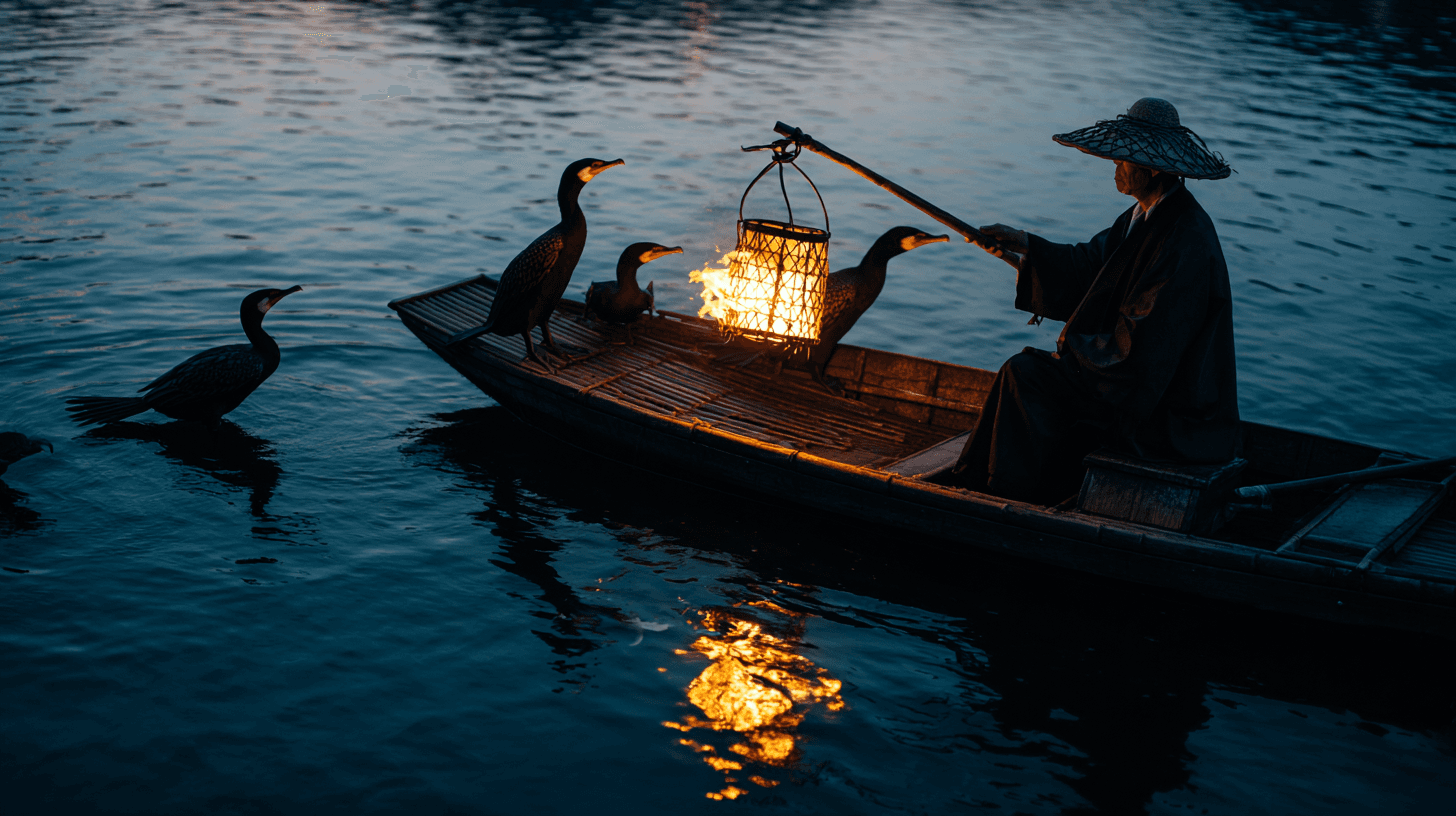
The bird dives. The fire blazes from the iron basket on the prow, casting flickering light across the water. The fish, drawn by the flames, swim upward into the cormorant's path. The bird catches, surfaces, returns to the boat, delivers the fish to its master.
Thirteen hundred years on the Nagara River.
This is ukai — cormorant fishing — a practice that has continued on Japan's Nagara River since at least the 7th century. The imperial household has patronized it for over a thousand years. The fishermen hold hereditary titles. The birds are treated as partners, not tools.
It makes no economic sense. It persists anyway.
The Method
A usho — a cormorant fishing master — works with 10 to 12 birds. Each bird wears a loose snare around the base of its throat, tight enough to prevent swallowing large fish but loose enough to allow breathing and swallowing of small ones. The snare is not cruel; it is the mechanism that makes the partnership work.
The torch attracts ayu — sweetfish — to the surface. The cormorants dive and catch them with speed and precision that no human technology can match. A skilled bird can catch a dozen fish in a single dive. The usho pulls the birds back by their leads, massages their throats to release the catch, and sends them out again.
The work happens at night because ayu are attracted to light and because the darkness hides the boat from the fish. The season runs from May to October, when the fish are running. A typical night might yield 20 to 50 kilograms of fish — enough to sell at premium prices to restaurants and hotels.
The Birds
The cormorants are wild-caught, usually as juveniles, and trained over several years. The training is not coercive. Cormorants are social birds with strong individual personalities. A bird that does not want to fish will not fish, regardless of training. The usho must build a relationship based on something other than force.
What that something is remains unclear. The birds are fed, but not dependent on the fishing for food. They are handled gently, but handling alone does not explain their cooperation. Some usho speak of the relationship in almost mystical terms — a bond that develops over years of working together, a mutual understanding that transcends training.
The birds work for 15 to 20 years. When they become too old to fish, they are retired and cared for until they die. Some usho hold funerals for their birds. The relationship is not merely commercial.
The Masters
There are six usho families on the Nagara River, all holding hereditary titles granted by the imperial household. The position passes from father to son; there has never been a female usho. The training takes a decade or more — learning to handle the birds, to read the river, to manage the boat and torch while controlling a dozen diving cormorants.
The usho are not wealthy. The fishing does not pay enough to justify the labor. They persist because of tradition, because of honor, because the title has been in their families for generations and abandoning it would be unthinkable.
The imperial connection helps. The emperor still receives ayu caught by cormorant, a tradition that dates to the 8th century. This patronage provides legitimacy and a small income. It also attracts tourists who pay to watch the fishing from boats that follow the usho down the river.
The Paradox
Ukai is economically irrational. Modern fishing methods are more efficient. The ayu could be caught more cheaply with nets or traps. The labor required — training birds for years, working through summer nights, maintaining boats and equipment — far exceeds the value of the catch.
Yet the practice continues. The six families have not broken the chain. Young men still learn from their fathers. The birds still dive in the torchlight.
Anthropologists have various explanations: cultural heritage, imperial patronage, tourist revenue, the prestige of hereditary titles. All are partially true. None fully explains why someone would choose this life when easier options exist.
Perhaps the explanation is simpler. The work is beautiful. The birds are remarkable. The tradition connects living practitioners to a thousand years of predecessors. Some things are done not because they make sense but because they matter.
What Remains
The torches still burn on the Nagara River in summer. The cormorants still dive and surface and return to the boats. The usho still guide them through the darkness, reading the water, managing the birds, practicing a craft that their distant ancestors would recognize.
Six families. Twelve boats. Perhaps 70 birds. A tradition that is tiny and fragile and has somehow survived into an age that has no rational place for it.
The birds fish because they have been trained to fish. The men fish because their fathers fished. The practice continues because stopping it would be a kind of death — the end of something that has persisted for 1,300 years, the breaking of a chain that has never been broken.
The cormorants dive into the dark water. The fish flash silver in the torchlight. The ancient work goes on.
Sources
- Laufer B. (1931). The Domestication of the Cormorant in China and Japan
- Nihon Ukai Gakkai (2015). Studies in Japanese Cormorant Fishing
- Gifu City Cormorant Fishing Museum Archives
- UNESCO Intangible Cultural Heritage: Cormorant fishing