Systems
The Camel Libraries
Books that walk
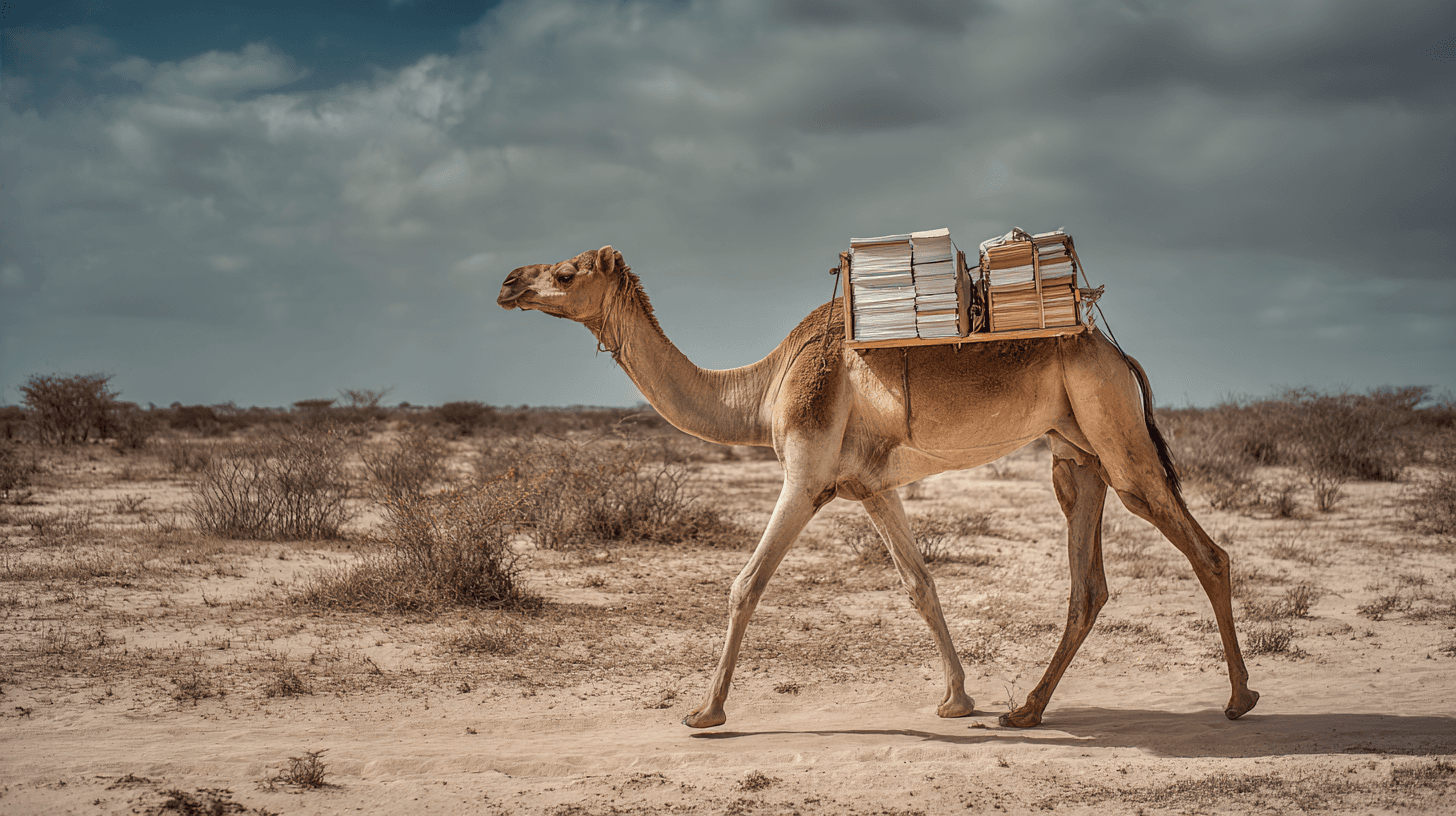
The camel carries 400 books. The children run to meet it.
In Kenya's northeastern regions, communities move with their livestock. Fixed libraries don't work — the people aren't there. So the library moves too.
The System
Kenya's Camel Mobile Library operates from Garissa. Camels carry boxes of books across the desert to communities that have no roads, no electricity, no fixed schools. The librarian arrives, sets up under a tree, and stays for a few days. People read. People borrow. The camel moves on.
The Numbers
Each camel carries approximately 400 books — divided between wooden boxes balanced on either side.
The service reaches communities across hundreds of kilometers of arid land.
Literacy rates in the region are among the lowest in Kenya. The mobile library is one of few educational resources available.
The Logic
The design problem: how do you provide library services to people who don't stay in one place?
The standard solution — build a library and expect people to visit — fails when the population is mobile. The library must go to the readers, not the reverse.
Camels are the optimal vehicle: they don't need roads, fuel, or spare parts. They handle terrain that would destroy a truck. They've been carrying goods across this landscape for centuries.
The Selection
Which books go? The collection includes children's books, literacy primers, texts in Somali and English, practical manuals. The selection changes based on community needs. A librarian who knows the route knows what people want.
The books that come back worn are the books that worked. Demand reveals itself through use.
The Replication
The model has spread. Donkey libraries in Ethiopia and Zimbabwe. Boat libraries in Bangladesh and the Philippines. Bicycle libraries in Ghana and Rwanda.
The principle is the same: bring the resource to the people. Fit the delivery method to the terrain.
The Gap
The camel library serves a population that formal education systems largely miss. Nomadic children in Kenya are far less likely to complete school than their settled peers. The mobile library doesn't fix this — but it provides something.
A child who reads, even intermittently, even from a camel's boxes under a tree, has access to something she didn't have before.
The Scene
The camel approaches. The children come running. The boxes open. For a few days, there are books. Then the camel walks on to the next community, and the books go with it.
The infrastructure is the animal. The library is wherever it stops.
Sources
- Kenya National Library Service Program Reports
- Knuth R. (2006). Camel library service to nomadic peoples
- UNESCO Mobile Libraries: Case Studies
- Alemna A. (1998). Library services in rural Africa