Systems
The Boat Builders
The ships that need no nails
There are no blueprints. There have never been blueprints.
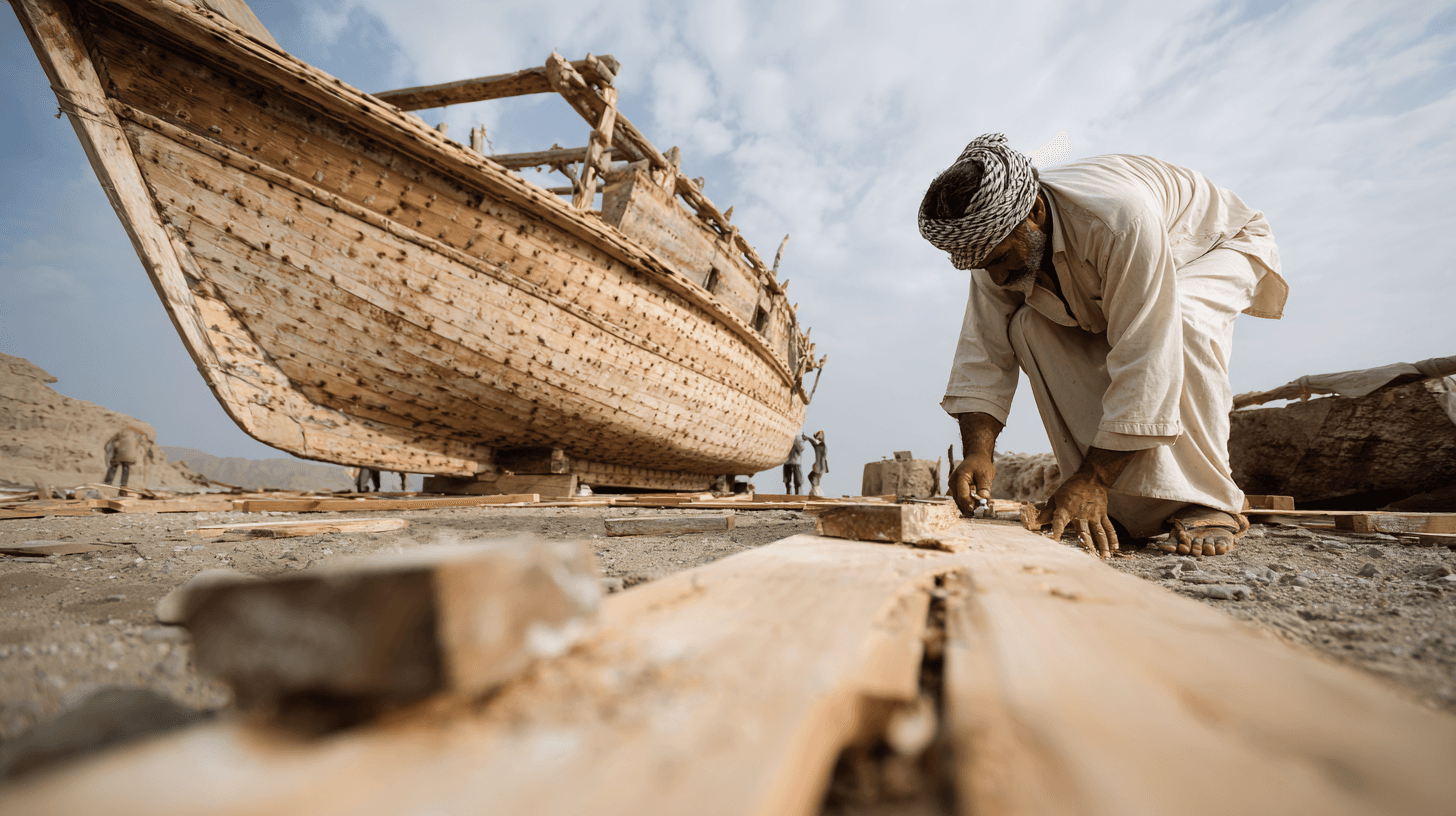
In Sur, Oman, dhow builders construct wooden sailing vessels up to 60 meters long without written plans. The proportions are in their hands. The curves are in their eyes. Each boat is one-of-one.
The Method
The keel is laid. Everything else follows from that first piece. The builder knows that the beam should be a certain fraction of length, that the stern should rise at a certain angle, that the planks should meet in particular ways.
These ratios aren't written. They're embodied. A builder who has worked for decades knows when something looks right or wrong. The knowledge is in the looking.
The Tradition
Dhows sailed the Indian Ocean trade routes for centuries. They carried spices, slaves, timber, dates — everything that moved between East Africa, Arabia, Persia, and India. The design evolved for those waters, those winds, those cargoes.
The boats were built on beaches with hand tools. Many still are.
The Present
Fiberglass and steel have replaced wood for most commercial vessels. The economics don't favor traditional construction: it's slower, more labor-intensive, requires skills that aren't common.
But dhows are still built. Some for fishing. Some for cargo in routes where wooden hulls still make sense. Some for wealthy patrons who want traditional craft.
The Knowledge
A master builder has apprentices. They learn by doing — shaping wood, fitting planks, watching the master assess. Over years, the eye develops. The hand learns what the mind can't articulate.
This transmission is fragile. It requires continuous practice. A generation without building means the knowledge is lost. You can't recover it from documents that don't exist.
The Demonstration
Sur has invested in showcasing its boatbuilding heritage. Tourists visit workshops. The process is explained. But demonstration isn't the same as practice.
A craft that survives only for display is already dying. The builders in Sur still build for use. That's what keeps the knowledge alive.
The Hull
The dhow hull is distinctive: narrow entry, wide beam amidships, high stern. The shape manages the monsoon winds and swells of the Indian Ocean.
It's also beautiful. The curves are fair — smooth transitions that please the eye. This is not an accident. Generations of refinement produced forms that are both functional and elegant.
No computer designed this. No engineer calculated the lines. Builders built, observed what worked, and remembered.
The memory persists. The boats still launch.
Sources
- Manguin P. (1993). Trading Ships of the South China Sea
- Horridge A. (1982). The Lashed-Lug Boat of the Eastern Archipelagoes
- Burningham N. (2019). Last of a Kind: Traditional Boats of Indonesia
- Gibson-Hill C. (1954). The Indonesian Trading Boat Reaching Singapore