Returns
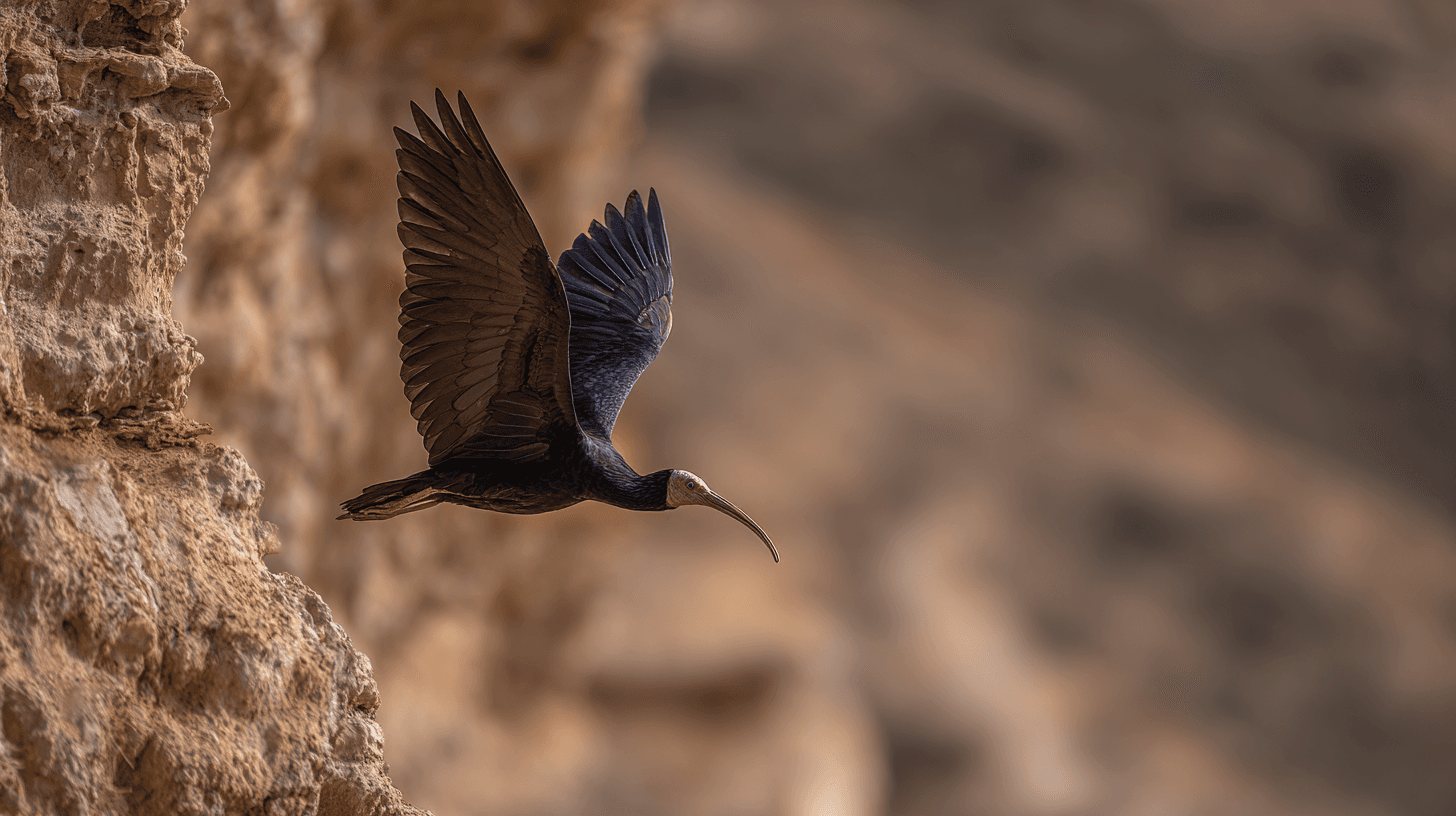
The Bald Ibis
The sacred bird that came back
The ancient Egyptians called it the "akh" — the spirit that returns after death.
The northern bald ibis appears in hieroglyphs dating back 5,000 years. It was sacred to Thoth, god of wisdom. Medieval European falconers hunted it. By 1989, the wild population in Morocco was down to 59 birds.
Today there are over 700. The species is recovering. The story of how involves GPS trackers, ultralight aircraft, and international diplomacy.
The Collapse
The northern bald ibis once ranged from Morocco to Syria, from Turkey to Yemen. Hunting, pesticides, and habitat loss collapsed the population across this entire range. By the late 20th century, only two wild colonies remained: one in Morocco, one in Syria.
The Syrian colony was discovered in 2002 — a population no one knew existed. By 2013, it was gone. War, drought, and hunting reduced it to a single bird, tracked by satellite until its signal went silent somewhere in Ethiopia.
The Moroccan population was the last.
The Intervention
The Souss-Massa National Park, south of Agadir, became the focus of intensive conservation. The colony was protected. Breeding success was monitored. Supplementary feeding helped during harsh years.
Meanwhile, European reintroduction programs launched. Conservationists raised chicks in captivity and taught them migration routes using ultralight aircraft — birds imprinting on machines, following human pilots south for the winter.
It sounds absurd. It worked.
The Numbers
Morocco's wild population: ~700 birds as of 2024, up from 59 in 1989. European reintroduction population: ~200 birds in Austria, Germany, Italy. IUCN status: Downgraded from Critically Endangered to Endangered in 2018.
The trajectory reversed. A species that spent a century declining is now increasing.
The Technology
GPS tracking changed everything. Researchers can now follow individual birds across continents, identify critical stopover sites, pinpoint threats.
When birds from the European reintroduction program started dying during migration, satellite data showed they were being electrocuted on power lines in Italy. The lines were modified. Deaths dropped.
When the Moroccan colony showed unexpected breeding failures, tracking data revealed that some birds weren't migrating properly — they were getting lost. The data allowed targeted intervention.
The Tension
Success creates new problems. The recovering population needs more habitat. Climate change is shifting the ranges of the insects they eat. Political instability in potential range countries complicates expansion.
And the technology that saved the species also tethers it to continuous monitoring. The birds are tracked, counted, managed. They are wild, but not entirely. They survive because humans decided they should survive and are willing to keep deciding.
The Question
The northern bald ibis is a conservation success story. The methods — GPS tracking, captive breeding, taught migration, habitat protection — are being applied to other species.
But what does it mean to "save" a species that exists only because of continuous human intervention? Is a bird that follows an ultralight aircraft still wild? Does it matter?
The akh returns. Five thousand years after the Egyptians carved its image in stone, the bird that was nearly extinct is increasing again. The spirit comes back — with a GPS collar and a team of scientists watching every move.
Sources
- IUCN Red List assessments; Souss-Massa National Park monitoring data; Waldrappteam European reintroduction project; BirdLife International tracking studies